
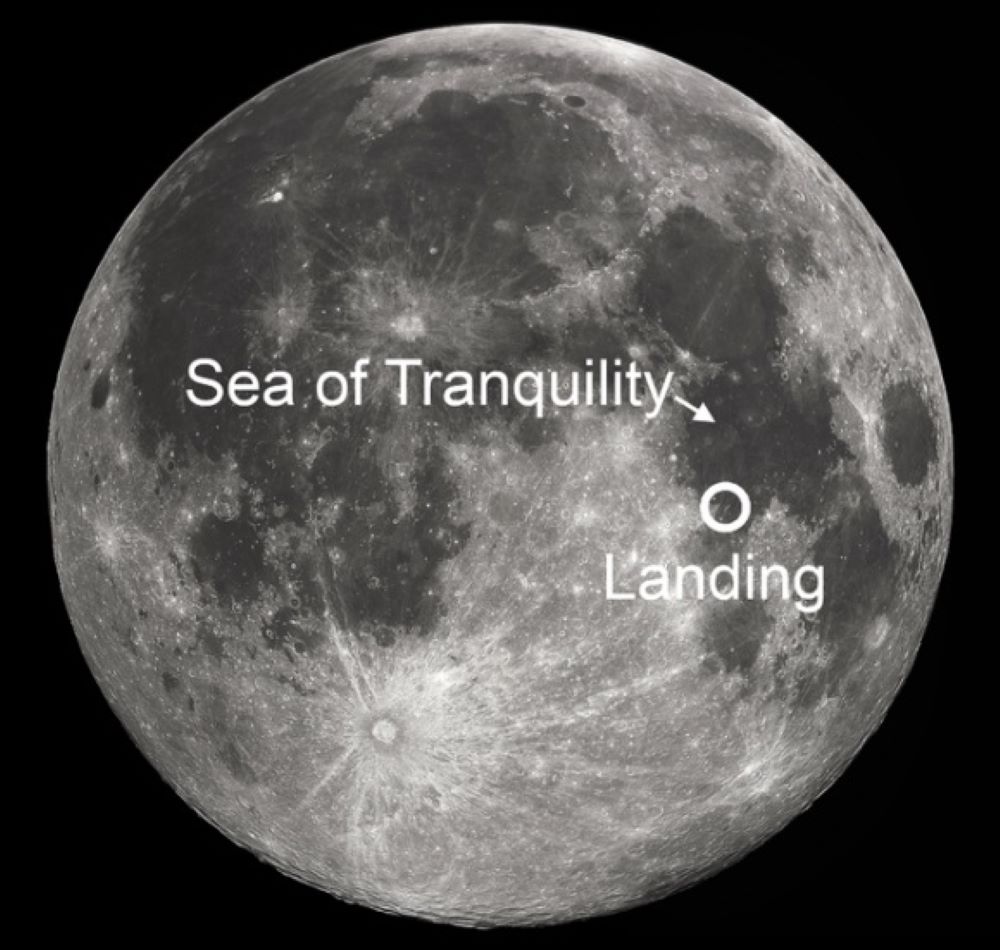
There’s been a lot in the media this week about a lava tube claimed to be newly discovered on the Moon, in Mare Tranquillitatis. As sometimes happens, much of the fuss is exaggerated. Some items have made a big deal out of the proximity to the Apollo 11 landing – but Mare Tranquillitatis is a big area of lava, one of the dark plains visible to the naked eye (Fig. 1). I haven’t found a map showing precisely where this one is, but it’s 400 km from the landing site.

Lava tubes are formed by liquid rock flowing below the surface, cooling at the edges. Even on Earth, they can extend for great distances: one on Hawaii, formed in a 19th century eruption, extends 50 km to the sea and possibly beyond. The longest one known is in southeast Asia (Fig. 2), and examples include the Thurston cave on Hawaii’s Big Island (Fig. 3), and the Kazamura cave, whose floor was the crust on a lava lake, which collapsed when the tube drained (Fig. 4). In many cases access to them is by roughly circular holes in the roofs, often called ‘skylights’.


The idea that such features might exist on the Moon and Mars, and be much larger as a result of their lower gravities, has been around for a long time. On the Moon there are many examples of ‘rilles’, which are long, linear depressions, extending for many miles. Some of them appear to be overlapping chairs of craters, far too many to be explained by impacts, and apparently formed by explosive outburst from below. NASA’s Grail probes found very large examples around the rim of the hemisphere visible from Earth; it’s thought these date from the Moon’s early history (Fig. 5) and were similar to the ‘fire curtains’ now seen on Hawaii (Fig. 6), though on a much larger scale.


It’s also thought that they released water from the lunar interior (Fig. 7), and may resemble the water geysers seen by the Cassini orbiter on Saturn’s moon Enceladus (Fig. 8).


But other linear features appear to have smooth, steep sides (Fig. 9), even in close-up (Fig. 10) and these are the ones thought possibly to be lava tubes.


For my book New Worlds for Old (1979), the late Ed Buckley recreated a typical ‘Old Moon’ illustration of such rilles as they would have been painted by pre-Apollo artists, winding between jagged lunar mountains (Fig. 11), and he contrasted it with a painting based on the only rille to have been visited so far, Hadley Rille, which was the target of Apollo 15 (Fig. 12).


Once again the different lighting conditions on the Moon had fooled previous artists, and Hadley Rille proved to be much wider than expected, with much gentler slopes. The astronauts Dave Scott and Jim Irwin believed they could have reached its floor with their Lunar Rover, although it was as deep as the Grand Canyon. Probably wisely, Mission Control refused to let them try it in case they couldn’t get back up, though they did go down some way on foot. Striations which they could see on the far wall suggested to them that the valley was a geological fault (Fig. 13), but the general view of geologists (technically, ‘selenologists’) was that it was a collapsed lava tube, though much larger than any known on Earth.

Skylights were found on Mars by a succession of spacecraft in the early 2000s, and one of the first detections on the Moon was by Japan’s Kayuga-Selene orbiter in 2008 (Fig. 14). That was in the Marius Hills, an area of volcanic features first identified by Lunar Orbiter 2 in the 1960s. The pit is 58 x 49 m in diameter and 40 m deep. It lies near the edge of a lava flow in an area of sinuous rilles, which appear to be collapsed lava tubes (Fig. 15), and it may have been opened by an impact on what’s now its rim (Fig. 16).


Lunar Reconnaissance Orbiter imaged one in Mare Ingenii which is twice the size of the Marius pit (Fig. 17), and over 200 are now known or suspected. The one in Mare Tranquillitatis is 140 x 146 metres across (Fig. 18).


It was actually discovered by Kayuga-Selene in 2009; what’s new is that on 15th June 2024 University of Trento professors Leonardo Carrer and Lorenzo Bruzzone published a study using radar imaging from LRO to determine its shape and structure below ground. Hitherto it was only an assumption that the tubes flanking the pits extended a long way left and right (Fig. 19); now it’s known that a hollow area 10-15 metres wide surrounds the pit on three sides, and a downward tunnel extends westward from a depth of 20 metres down to at least 105 (Fig. 20).


Initial studies by Astrobotic showed a stylized simple rover exploring one of the Kayuga tubes (Fig. 21), sending data at low rates through the rock to a surface rover above (Figs. 22 & 23).


Boulders on the visible floor below the collapse are 10 metres across, so getting to a smoother floor beyond may not be easy even if there is one. Flying in a drone (Figs. 24) or landing a rover (Fig. 25) may be considerably easier said than done, given the difficulties which have beset recent lunar landings.


‘Pitbots’ flying around the interior might do better (Figs. 26 and 27), but all such operations would be easier on Mars with helicopters, like the recently broken Ingenuity, making use of the atmosphere which the Moon doesn’t have.


The attraction of all this is the shelter that lava tubes could provide for human explorers, from extremes of temperature in the first instance. Due to the overhang of the edges, temperatures on the Tranquillitatis pit floor are typically 63° F, 17° C. But more significantly, explorers, bases and ultimately settlements would be protected from solar particle storms, emitted by Coronal Mass Ejections (see ‘Martian Dust-storms’, ON, 23rd June 2024). Longer-term shielding from primary cosmic rays is also needed, and would be provided by 10 feet of rock – but how much easier to go into a tunnel than to pile up soil over habitats on the surface. An ESA team of 36 astronauts from 5 national agencies are already taking part in two training programmes, CAVES and PANGAEA, with support from universities including Padua and Bologna, including onsite work in caves on Lanzarote (Figs. 28, 29 & 30).


But as British astronaut Helen Sharman has pointed out, since the pit walls are sheer, human explorers are going to need jetpacks or similarly exotic systems just to get in and out of the skylights (Fig. 31).

Already there are studies of a possible lunar base in a lava tube at Philolaus crater near the lunar north pole (Figs. 32 and 33).


The Marius Hills tubes may be gigantic, large enough to hold the city of Philadelphia (Figs. 34 & 35).


In Kim Stanley Robinson’s novel Red Moon (review, ON, January 15th, 2023), the characters visit an entire tube which has been sealed and pressurised by a multi-billionaire for his own use. That could be equivalent to what the late Prof. Oscar Schwiglhofer characterised as ‘half-terraforming’, producing earthlike conditions on the Moon within huge subsurface caves (within which humans could fly by muscle power alone, as Robert A. Heinlein pointed out in The Menace from Earth, Dobson 1966). It would perhaps not be so easy, since most of its volume would have to be filled with an inert gas like nitrogen, which is 80% of Earth’s atmosphere, but not plentiful in the Solar System except in the atmosphere of Titan.

But in the discussions which led to my Man and the Planets (Ashgrove Press, 1983), Ed Buckley suggested that the Marius Hills may hold an interesting alternative. Their volcanic features which first attracted attention in the Lunar Orbiter 2 images were volcanic domes, 200-500 feet high (Fig. 36), and as they were formed by uplift, there might be numerous fissures on their surfaces, leading to large hollows in the interior, and ideal for settlement on the flat, without the difficulties of going underground. I had hoped to use his painting with its subtle colours (Fig. 37) as the Frontispiece for Man and the Planets, but because the US rights didn’t sell, the interior artwork for the book was all in black and white. So Orkney News gets its first appearance in colour, after all these years.

Duncan Lunan’s recent books are available through Amazon. For more information see Duncan’s website, www.duncanlunan.com.



Leave a Reply to The Sky Above You, March 2026 – The Orkney NewsCancel reply