
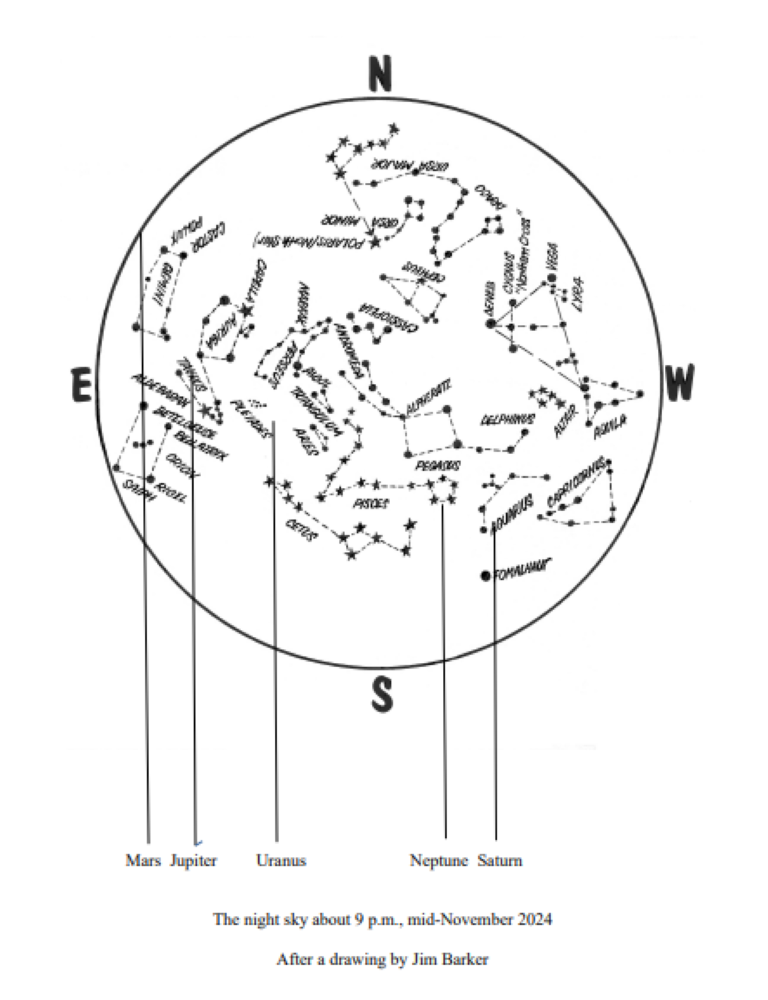

The Moon is New on November 1st, and Full on November 15th, another ‘Supermoon’ at its closest to Earth. The crescent Moon is near Venus on the early evening of November 5th, below Saturn on the 10th, near Jupiter on the 17th, and near Mars on the 20th.
NASA’s CAPSTONE cubesat, which was placed in elliptical orbit by a Rocket Lab Electron booster in 2022, has completed four years in orbit and nearly 100 passes over the lunar poles, and is still operational checking out the communications possibilities for future missions, so its lifetime has been extended at least till the end of 2025.
The planet Mercury is still not visible, though it will be furthest from the Sun in twilight on November 16th.
Venus starts low in the evening sky, setting about 6 p.m., near the crescent Moon on the 5th, but visible against a dark sky and setting near 7 p.m. by the end of the month.
Mars rises at about 9.00 pm in Gemini, east and below Castor and Pollux, passed by the Moon on the 20th. At the end of November Mars passes above the Open Cluster Praesepe, ‘the Beehive’, in Cancer. From time to time indications are found that there may have been volcanic activity on Mars within the last 10 million years, and the latest comes from gravity mapping suggesting a rising plume of magma, currently 1100 km below the largest volcano in the Solar System, Olympus Mons. (Anon, ‘Rising Plume Could Awaken Mars’ Volcanoes’, Astronomy Now, November 2024.) That’s a long way down, but taken in conjunction with recent discoveries of liquid water below the Martian crust (see ‘The Sky Above You’, October 2024), a Krakatoa-style eruption in the future can’t be ruled out.
Jupiter is still between the horns of Taurus, rising at 6.30 p.m., and is passed by the Moon on the 17th, as above. Jupiter is brilliant as it approaches opposition, at its closest to us on 7th December. Transits of Jupiter’s large moons and their shadows continue, for instance with the shadow of Ganymede crossing the planet on November 3rd, and both Io and its shadow doing so on November 17th.


After the successful launch of Europa Clipper on October 14th (Fig. 1), more details of the plan are attracting attention. The spacecraft’s slingshot around Mars will be on March 1st 2025 – the launch delay due to Hurricane Milton has pushed it back from 27th February (Fig. 2), but even so, it shows you how fast it’s going at the moment, and to get the necessary leverage it will pass between 300 and 600 miles from the surface. There will be a return to Earth on 3rd December 2026 (not 1st December, now), ‘no closer than 2000 miles’ (Robert Lea, ‘What’s next for NASA’s Europa Clipper? The long road to Jupiter and its moons’, Space.com, online, 27th October 2024). On arrival at Jupiter on 11th April 2030, after a six-hour deceleration there will be a braking flyby of Ganymede, apparently before the instruments are switched on in May, which seems like a pity. 49 flybys of Europa are then scheduled over the next three years, before a final deorbit into Ganymede in September 2034. The reasoning here is that although Ganymede is known to contain liquid water like Europa’s (Fig. 3), it’s at greater depth and less likely to reach the surface, so any contamination of it would be local. I can’t help thinking that some of these plans may alter over the next ten years, if only because of the Ganymede flybys made by the Juno spacecraft in 2019-2021.

Saturn in Aquarius sets at 0.30 a.m., and the Moon passes just below it on the evening of the 10th, occulting the planet as seen from southern US sites such as Miami. On the 16th Saturn comes to its ‘stationary point’, after which it will resume its eastward motion against the stars after being passed by the Earth on September 8th.
Uranus in Taurus is at its closest to us, at opposition on the 17th, due south at midnight, the night after it’s passed by the Moon. Uranus is west of the V-shaped Hyades cluster in Taurus, on the boundary between Taurus and Aries, and at opposition it will be six degrees south-west of the Pleiades, close enough to be found in the same field of view with binoculars. 38 years after Voyager 2 passed the planet in 1986, its north pole is now turned towards us and a large white polar cloud cap can be seen in large telescopes. Over 2023-2024 Uranus has been imaged for comparison by the Hubble Space Telescope in Earth orbit, the James Webb Space Telescope a million miles further out at the Sun-Earth L1 point, and by the New Horizons space probe, now 6.5 billion miles further out and observing Uranus from a different angle (Figs. 4, 5 & 6). The results will be useful in interpreting images of exoplanets orbiting other stars, especially after the launch of the Nancy Grace Roman Space Telescope in 2027. (Robert Lea, ‘NASA images Uranus with epic team up of Hubble Telescope and New Horizons Pluto probe’, Space.com, 11th October 2024; Anon, ‘Uranus Rides High at Opposition’, Astronomy Now, November 2024.)


Neptune, between Aquarius and Pisces sets at 2 a.m., and is near the Moon on the 12th.
The Leonid meteors from Comet Tempel-Tuttle peak on the night of 17th/18th November, but visibility will be much spoiled by moonlight.
Comet Tsuchinshan-ATLAS, aka Comet A3, survived passing the Sun and is being called ‘the comet of the century’ (to which add ‘so far’, unless being really pessimistic). It’s in the evening sky but will be below naked-eye visibility by November, though still trackable with binoculars and small telescopes (Fig. 7).

Comet C/2024 S1 (ATLAS), aka Comet S1, discovered on September 27th, might have become as bright as the planet Venus and visible in daylight, if it survived solar passage on October 28th. But as it was one of the very large family of Kreutz sungrazing comets, dating from a supercomet breakup in the past (before 371 BC at least), its chances were not good. Few Kreutz comets survive solar passage, and this was no exception. Observations between 3rd and 8th October, at the Siding Spring observatory in Australia, suggested the nucleus might already be breaking up, and on the 28th itself the comet simply faded from view as it approached the Sun through the field of the faithful SOHO spacecraft at the Sun-Earth L1 point (see ‘Space Notes’, September 2024). For the video of the disappearance see Kelly Kizer Whitt & Will Triggs, ‘Has October’s 2nd comet – the sungrazer Comet S1 – disintegrated?’, (EarthSky, October 28th 2024).
The James Webb Space Telescope has found the first direct evidence of jets emanating from a Centaur, once designated as a comet, one of a number of objects emanating from the Kuiper Belt beyond Pluto and now orbiting between Jupiter and Neptune. The first such object to be discovered was Chiron, in 1977, named after one of the Centaurs in Greek mythology, which gave the general name to the rest. It seemed highly likely that Phoebe, the far outer moon of Saturn, was an example, and the complex chemistry detected on its surface by the Cassini spacecraft in 2004 made that still more likely (Figs. 8 & 9).


Even before New Horizons reached Pluto and discovered its complex surface chemistry, it was suggested that there was evidence of outbreaks and possible glaciers on its major moon, Charon (not to be confused with Chiron, as it often is). Then it was suggested that similar outbreaks might occur even on small objects in the Kuiper Belt (Fig. 10), and in January this year, the JWST found evidence of them in the isotope ratios of methane on the surfaces of two of them, Eris and Makemake (Fig. 11).


Now JWST has detected actual outbreaks from Centaur Schwassman-Wachmann 1, both carbon monoxide and carbon dioxide from the northern hemisphere and carbon monoxide alone from the south (Figs. 12 & 13).


No water emissions were detected, probably due to the very low temperature at that distance from the Sun, but the different emissions from the two hemispheres may indicate that Schwassman-Wachmann 1 is a ‘contact binary’, an amalgamation of two or more icy objects, like the ‘duck’ of Comet 67P, studied in detail by ESA’s Rosetta probe (Fig. 14) and the Kuiper Belt’s Ultima Thule, renamed ‘Arrokoth’ after the New Horizons flyby of 2019 (Fig. 15). Like Arrokoth’s, Schwassman-Wachmann 1’s colour is light brown. Now that analysis of the returned samples from asteroid Bennu indicate that some of them are as old as the Solar System or even older, it’s no exaggeration that discoveries like these may change our perception of its early history.


Since 2020 the Subaru telescope on Mauna Kea in Hawaii (Fig. 16) has been searching for possible new targets for New Horizons, for its Long Range Reconnaissance Imager if not for another flyby like the one of Arrokoth in January 2019. None have been found so far, which has led to controversial proposals to reallocate much of the team to other duties, not implemented so far. But to date the Subaru search has found 239 previously unknown objects, 228 of them within the known bounds of the Kuiper Belt, but another 11 lie outside it. If they indicate a second Kuiper Belt starting 2.25 billion km further out, that would make the dimensions of the Solar System comparable with similar belts seen in exoplanet systems. (Anon, ‘A Second Kuiper Belt May Lurk Far from the Sun’, Astronomy Now, November 2024.)

Duncan Lunan’s recent books are available through Amazon; details are on Duncan’s website, http://www.duncanlunan.com.
You can download a copy of the Sky Map for November 2024 here:




Leave a Reply