
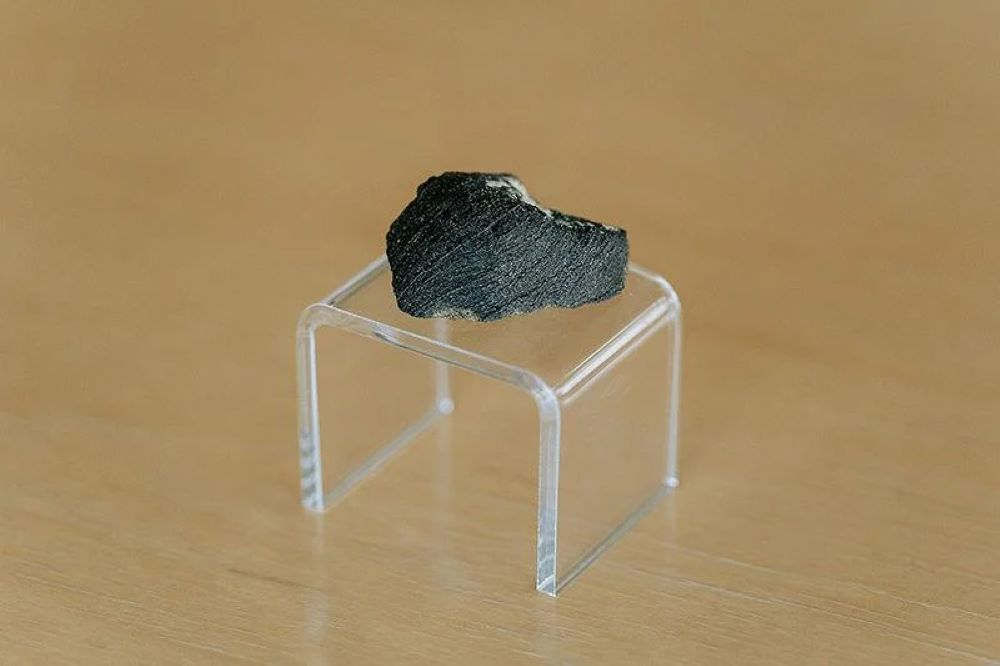

During early investigations of the Lafayette Meteorite, scientists discovered that it had interacted with liquid water while on Mars. Scientists have long wondered when that interaction with liquid water took place. An international collaboration of scientists including two from Purdue University’s College of Science have recently determined the age of the minerals in the Lafayette Meteorite that formed when there was liquid water. The team has published its findings in Geochemical Perspective Letters.
Marissa Tremblay, assistant professor with the Department of Earth, Atmospheric, and Planetary Sciences (EAPS) at Purdue University, and the lead author explained:
“We dated these minerals in the Martian meteorite Lafayette and found that they formed 742 million years ago. We do not think there was abundant liquid water on the surface of Mars at this time. Instead, we think the water came from the melting of nearby subsurface ice called permafrost, and that the permafrost melting was caused by magmatic activity that still occurs periodically on Mars to the present day.”
Ryan Ickert, senior research scientist with Purdue EAPS, a co-author of the paper added:
“This meteorite uniquely has evidence that it has reacted with water. The exact date of this was controversial, and our publication dates when water was present.”
Thanks to research, quite a bit is known about the Lafayette Meteorite’s origin story. It was ejected from the surface of Mars about 11 million years ago by an impact event.
“We know this because once it was ejected from Mars, the meteorite experienced bombardment by cosmic ray particles in outer space, that caused certain isotopes to be produced in Lafayette,” Tremblay said.
“Many meteoroids are produced by impacts on Mars and other planetary bodies, but only a handful will eventually fall to Earth.”
But once Lafayette hit Earth, the story gets a little muddy. It is known for certain that the meteorite was found in a drawer at Purdue University in 1931. But how it got there is still a mystery.
“We used organic contaminants from Earth found on Lafayette (specifically, crop diseases) that were particularly prevalent in certain years to narrow down when it might have fallen, and whether the meteorite fall may have been witnessed by someone.”
The team involved included an international collaboration of scientists: Darren F. Mark, Dan N. Barfod, Benjamin E. Cohen, Martin R. Lee, Tim Tomkinson and Caroline L. Smith representing the Scottish Universities Environmental Research Centre (SUERC), the Department of Earth and Environmental Science at the University of St Andrews, the School of Geographical and Earth Sciences at the University of Glasgow, the School of Earth Sciences at the University of Bristol, and the Science Group at The Natural History Museum in London.
“Before moving to Purdue, Ryan and I were both based at the Scottish Universities Environmental Research Centre, where the argon-argon isotopic analyses of the alteration minerals in Lafayette took place” Tremblay said.
“Our collaborators at SUERC, the University of Glasgow, and the Natural History Museum have previously done a lot of work studying the history of Lafayette.”
Dating the alteration minerals in Lafayette and, more generally, in this class of meteorites from Mars called nakhlites, has been a long-term objective in planetary science because scientists know that the alteration happened in the presence of liquid water on Mars. However, these materials are especially difficult to date, and previous attempts at dating them had either been very uncertain and/or likely affected by processes other than aqueous alteration.
Click on this link to access, Dating recent aqueous activity on Mars, published in Geochemical Perspectives Letters




Leave a Reply