
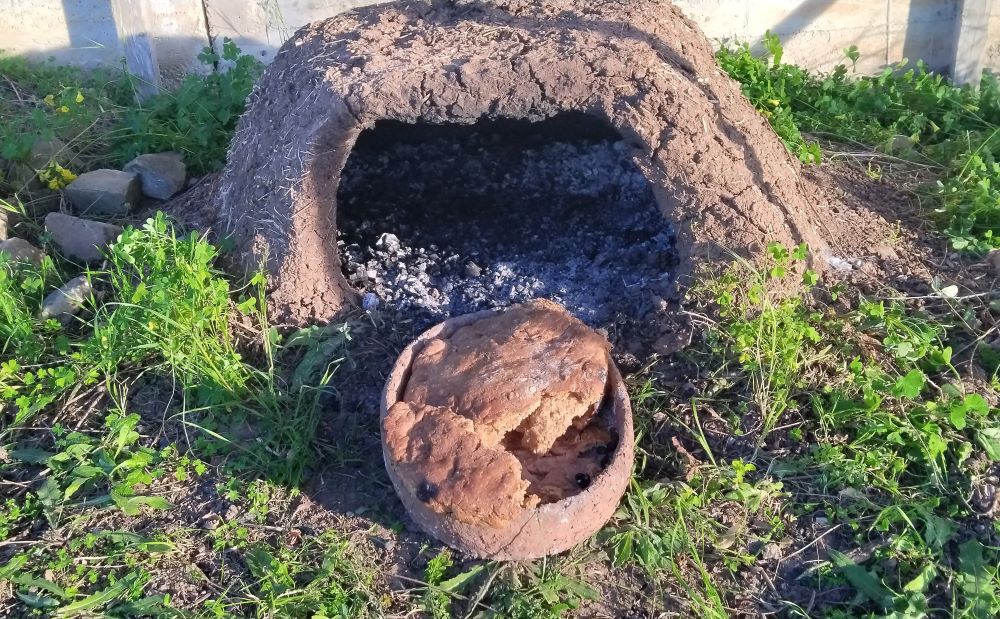
During the Late Neolithic, between 7000 and 5000 BCE, the fully agricultural communities in the Fertile Crescent region of the Near East, developed a complex culinary tradition that included the baking of large loaves of bread and “focaccias” with different flavours on special trays known to archaeologists as husking trays.

The study was led by researchers from the UAB and the University La Sapienza in Romeand also involved staff from the Milà i Fontanals Institution (IMF-CSIC) and the University of Lyon (France).
The husking trays were containers with a large oval base and low walls, made of coarse clay. They differed from common trays due to their internal surface, marked with rough impressions or incisions arranged repetitively and regularly.
Previous experiments using replicas of these trays and cooking structures similar to those found at archaeological sites from the studied period had already allowed researchers to hypothesize their function. These investigations suggested that large loaves made with water and flour might have been baked on these trays, placed in domed ovens for about 2 hours at an initial temperature of 420°C. The grooves on the internal surface would have facilitated the removal of the bread once baked. Moreover, the large size of the loaves, approximately 3 kg, suggested they were likely intended for communal consumption.

The research team analyzed ceramic fragments of husking trays from between 6400 and 5900 BCE to identify their use as specialized containers for baking cereal-based doughs and whether these doughs could have been seasoned with products such as animal fat or vegetable oil. The analyzed remains come from the archaeological sites of Mezraa Teleilat, Akarçay Tepe, and Tell Sabi Abyad, located in the area between Syria and Turkey. The analyses were carried out at the Universities of Istanbul and the Koç (Turkey).
The analysis of phytoliths (silica residues from plants) suggests that cereals such as wheat (Triticum sp.) or barley (Hordeum sp.), reduced to flour, were processed in these trays. Furthermore, the analysis of organic residues indicates that some of the trays were used to cook foods containing animal-derived ingredients, such as animal fat, and in one case, plant-based seasonings.
The degradation state of the residues suggests that, in at least two cases, the trays reached temperatures compatible with those experimentally verified for baking dough in domed ovens. Finally, the use-alterations analysis of the ceramic surface allowed the identification of use-wear specifically associated with bread residues and others linked to seasoned focaccia residues.
Sergio Taranto, lead author of the study, part of a doctoral thesis carried out at the UAB and La Sapienza, explained:
“Our study offers a vivid picture of communities using the cereals they cultivated to prepare breads and ‘focaccias’ enriched with various ingredients and consumed in groups.
“The use of the husking trays we identified leads us to consider that this Late Neolithic culinary tradition developed over approximately six centuries and was practiced in a wide area of the Near East.”
Researchers from the UAB’s Prehistoric Archaeology of the Near East Research Group (SAPPO), Adrià Breu, Anna Bach, and Miquel Molist, are also authors of the study, Unveiling the culinary tradition of ‘focaccia’ in Late Neolithic Mesopotamia by way of the integration of use-wear, phytolith & organic-residue analyses, published in Nature, Scientific Reports.



Leave a Reply