
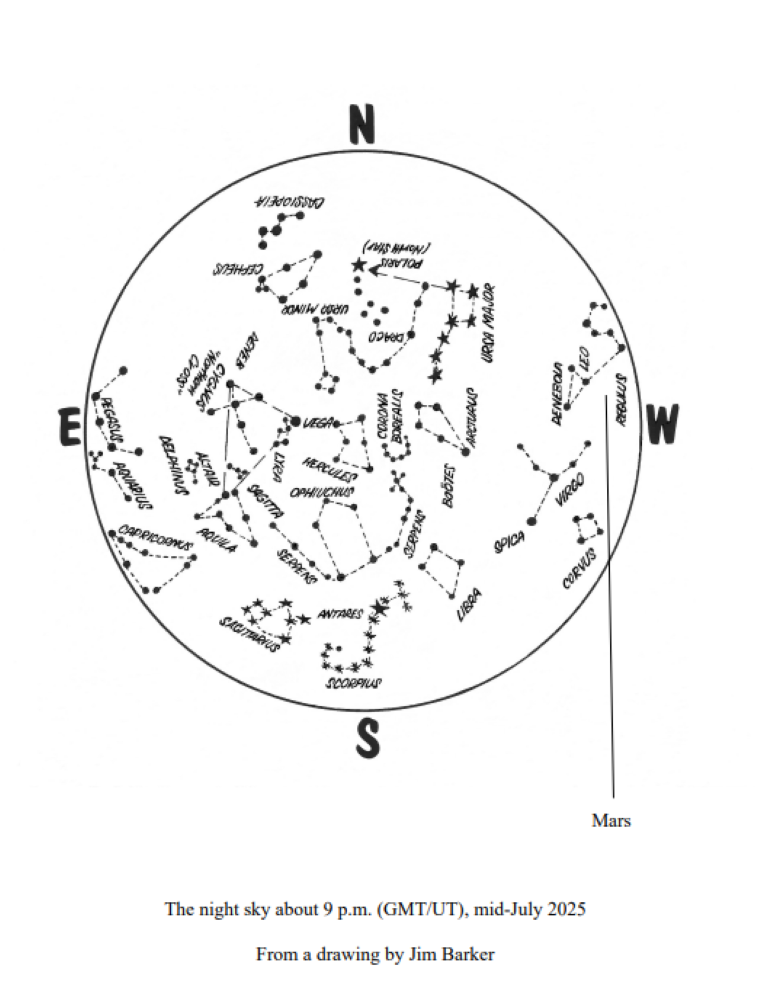

The Moon is Full on July 10th, and it will be New on July 24th. It passes Saturn on the 15th, Venus on the 21st and 22nd, Jupiter on the 23rd and Mars on the 28th. There are no planets visible in the evening sky unless you count Mars, which will be setting as it gets dark in Scotland.
It has been confirmed that the crash of the Japanese lunar lander Resilience in Mare Frigoris on 5th June (Fig. 1) was due to a failure of the laser altimeter, in the final stage of approach (Fig. 2).


There are four possible causes, including an anomalous return from the lunar surface, and all are under investigation. The July issue of Astronomy Now has a 2-page article on Mare Frigoris, ‘Warm to the Sea of Cold’, starting with the crater Harpalus, modelled in detail by Chesley Bonestell for the US spaceship landing in the 1950 film Destination Moon (Fig. 3), and afterwards featured in Cornelius Ryan, ed., Man on the Moon (Sidgwick & Jackson, 1953).

In June the European Space Agency released the first images of the south pole of the Sun (Fig. 4), obtained by the Solar Orbiter probe as it continues to increase its elevation above the solar equator, in repeated flybys of the planet Venus.


It’s now at an elevation of 17 degrees, and will change up to 24 degrees in December 2025 and 33 degrees in June 2029 (Fig. 5).

The magnetic map of the polar region shows areas of north and south polarity (Fig. 6, top centre), suggesting that the Sun’s magnetic field is about to flip, as it does every 11 years in conjunction with the sunspot cycle, which is now approaching maximum activity. These are the first direct studies of the solar poles since the International Solar Probe Mission of 1990 (Fig. 7), which was to have consisted of two probes launched simultaneously, to go over the poles of Jupiter (Fig. 8) and then the Sun’s (Fig. 9).


The US contribution was cancelled, causing such disappointment that Margaret Thatcher was moved to protest, to no avail. But the ESA ISPM ‘Ulysses’, in which Britain had a major part, did not carry cameras because it was felt that the results wouldn’t justify doing so, which may now turn out to be wrong. Solar Orbiter has been excluded from the list of missions NASA is being forced to cut, which is nice of them of since it’s not their spacecraft, but presumably it means that what’s left of the Solar Physics Division will still be allowed to look on. The same applies to SOHO, which has been operational since 1995 after a remarkable long-distance rescue by ESA technicians in 1998, and to PUNCH, the recently launched US solar observer, which returned its first coronagraph film of a solar outburst on June 3rd. Its resolution is higher than SOHO’s, which frequently captures Sun-grazing comets and planets in conjunction with the Sun (see ‘The Sky Above You, May 2025′, ON, 1st May 2025), but the PUNCH film shows the constellation Orion behind the Sun, including the four principal stars, the three stars of the Belt and even the Great Nebula in the Sword (C. Alex Young, Raúl Cortés and Armando Caussade, ‘Sun news: First eruption imagery from PUNCH mission!’, EarthSky, online, 12th June 2025.)

The pushing back of radiocarbon dating correlated with tree rings has reached 12,350 BC, revealing the largest known Coronal Mass Ejection from the Sun to have hit the Earth, with evidence in tree rings worldwide (Fig. 10). Surprisingly, it seems that Earth’s magnetic shield was then weaker, so there was less carbon-12 in the atmosphere being turned into carbon-14. I would expect such an event to permit more penetration by cosmic rays, more cloud formation and global cooling, but this was in the Late Glacial Period, when the Ice Age was already retreating ( Andy Tomaswyk, ‘New Algorithm Details the Most Extreme Particle Storm Known to Science’, Universe Today, 19th May 2025; Teresa Pultarova, ‘14,000 years ago, the most powerful solar storm ever recorded hit Earth. “This event establishes a new worst-case scenario”‘, Space.com, online, 19th May 2025.) Similar events occurred in 7176 BC, 5259 BC, 663 BC, 775 AD (the second most powerful known), 994 AD (recorded in English and Chinese chronicles as aurora), but otherwise affecting only the growth of tree rings.

The most severe such CME in recorded history was the Carrington Event of September 1st, 1859 (Fig. 11), when aurora were seen as far south as El Salvador, and as far north as Santiago in Chile, and the currents induced by fluctuations in the magnetic field were powerful enough to set fire to telegraph stations worldwide. (Henry Wismeyer, ‘The Unseen Fury of Solar Storms’, NEOEMA, The Bergen Institute, June 24th 2025, reprinted as ‘Meet the Solar Storm Chasers’, Nature Briefing, 27th June 2025. This very comprehensive article, billed as a 24-minute read, goes into the nature, history and danger of CMEs in detail.)


A similar event now (Figs. 12-15) would hit every device carrying or capable of carrying a current, from power stations, hospital generators, aircraft systems all the way down to humble domestic appliances, either mains-powered or battery.

CMEs are detected by satellites (Fig. 16), most of which are now to be turned off by orders of the Trump administration, and generally take about three days to reach the Earth. If they’re magnetically oriented the same way as the magnetic field they are usually rebuffed, but with the opposite polarity they saturate the Van Allen radiation belts, overloading them and dumping particles into the ionosphere to cause aurorae and geomagnetic storms. The orientation can’t be determined until the shock-front passes space probes like SOHO at the Sun-Earth L1 point, at which point there’s 30 minutes’ warning in which to turn off all the electrical devices on Earth. A recent simulation showed that terrestrial authorities are almost completely unprepared for it (Teresa Pultarova, ‘The US isn’t prepared for a big solar storm, exercise finds’, Space.com, 9th May 2025). Wismeyer’s article above concludes, ‘At the time of writing, the latest American Space Weather Implementation Plan, updated last year by the Biden administration, has been removed from the U.S. government’s websites’, which does not augur well.


We might have had one in 2012, but luckily enough it was on the far side of the Sun and missed us completely (Figs. 17 & 18). There’s some slight consolation in that the southward extent of the blackout depends on the severity of the storm (Fig. 19), but not much consolation for Scotland, since we’re on the latitude of Labrador and off the top of the map.

Even as I write, we’ve just passed an event in which a ‘normal’ CME was possibly going to generate aurora down to geomagnetic latitudes 45 north and south, i.e. down to Alabama in the USA. (Daisy Dobrijevic, ‘Northern lights may be visible in these 20 US States tonight [updated]’, Space.com, 31st May 2025.)
Currently the Sun is being monitored in real time by the Met Office’s Space Weather Observation Centre (MOSWOC) in the UK, and two other centres in Boulder, Colorado, and Adelaide, Australia. Space Weather was first added to the U.K. National Risk Register in 2012. In 2023, its threat level was increased from level 3 (moderate) to level 4 (significant), which includes floods and emergent infectious diseases.

Dr Mansavi Lingam and Prof. Avi Loeb have suggested that a solar shield at L1 could protect the Earth (Fig. 20), but “The shield would basically be a huge loop of 1 centimetre-thick copper wire, roughly the size of Earth, and weighing 90 million kilograms (198 million pounds). The scientists don’t provide too many details on actually building it, other than noting that we could use asteroids to get the necessary materials for it in space.” It might be feasible within 150 years (Jonathan O’Callaghan, ‘Earth-Sized Magnetic Shield Could Save Us From Superflares’, IFL Science, online, October 3rd 2017), but as both scientists are at Harvard, currently the focus of Donald Trump’s attack on academia, I don’t think much will be done anytime soon. As just one minor part of that, the world’s most powerful solar observatory, the Daniel K. Inouye one on Maui, Hawaii, is threatened with closure after only three years of use, as part of the general wipe-out of the National Science Foundation budget, even though the preservation of civilisation depends at least partly on its studies.
The planet Mercury is invisible near the Sun in July, though at greatest elongation from it on July 4th, and reaches inferior conjunction on this side of the Sun on August 1st.
Venus in Aries rises at 2 a.m., very bright in the morning sky, in line with Uranus and the Pleiades on the 4th, passed by the Moon on the 21st and 22nd.
Mars is low in Leo, moving into Virgo on the 28th, setting about 11 p.m. when the sky is barely dark here. The Moon is near Mars on July 28th, though hard to see by then.
Although the Perseverance lander went to Jezero crater in search of sedimentary rocks, and did find them in the delta of the river which broke through the crater wall long ago, surprisingly it has also found volcanic rocks, not only on the crater floor but also on the river floor (possibly washed downstream), and also on the rim, suggesting possible ejection from a volcano somewhere in the vicinity. On December 10th 2024 it reached Lookout Hill, on the inner rim (see ‘The Sky Above You, January 2025, ON, 1st January 2025). From there it saw terrain outside the crater for the first time, revealing a volcanic hill in the middle distance, and beyond it two near identical peaks which can be seen from orbit, on either side of a long chasm which is obviously younger than they are, possibly formed by the impact. When I wrote these up in January, I could only find them in YouTube videos (Mars Guy, ‘Perseverance Tops Out and Looks Beyond’, December 15th, 2024), and frustratingly that’s still the case. The only still image I can find is looking west, towards the crater rim (Fig. 21), and the only map doesn’t show them either (Fig. 22).


But now a much larger feature on the southwest of the rim, previously designated Jezero Mons, has been identified as a volcano 13 miles across, nearly half the size of Jezero crater itself (Figs. 23-25).


How old it is has still to be determined, but it looks as if it was active after the crater formed, if not before. That it has remained ‘hidden in plain sight’ all this time suggests to me that it may have been mostly buried by the impact. Commentators have remarked on the similarity to the huge extinct volcano in Noctis Labyrinthis, undiscovered since the feature was photographed by Mariner 9 in 1971, which I wrote up in ‘The Sky Above You, April 2024’ (ON, 3rd April 2024), but this one is on the crater rim, whereas the Noctis one has largely been destroyed by water action – much as the outer layers of Ailsa Craig have been washed away, leaving only the central granite plug (Fig. 26).

On hearing that, my sister remarked, “They must have used a very strong detergent”.
By mid-month Jupiter rises about 3.30 a.m., in Gemini, below and left of Venus, near the waning crescent Moon on the 23rd, still very low (‘barely up from Scotland’, according to Astronomy Now).
Saturn in Pisces rises about 1.30 a.m., within a degree of Neptune all month. As the Earth catches up with Saturn in their orbits, Saturn is ‘stationary’ on July 14th, and the Moon will be near Saturn on the 15th. In ‘The Sky Above You’ for May (ON, 1st May 2025), I quoted Nigel Henbest, in Stargazing 2025, saying that Saturn should look markedly different when now we’re observing the rings from the other side, from below instead of above. This has now been proved true in a photograph by Robert Lunsford of California on May 31st, 2025, showing the shadowed side of the rings, with Titan’s shadow on the northern hemisphere of Saturn, and Titan itself at the 10 o’clock position (Fig. 27).

Titan is almost the largest moon in the Solar System, second only to Jupiter’s Ganymede, and it’s the only moon with a dense atmosphere. Normally it’s easily seen with even a small telescope (it was prominent in the 3-inch refractor which I had from 1967 till the mid-80s), but it’s not so easy to see when the Saturn system is edge-on to us, as at present, and due to low contrast it’s particularly hard to see crossing the planet, which happens only every 15 years. Its shadow is much more prominent, and shadow transits will continue until October – a full list of them can be found in Bob King, ‘Titan Shadow Transit Season Underway’, Sky & Telescope online, May 14th 2025. The moon itself will continue to transit the planet every 16 days until January 25th – no doubt Burns would approve. Meanwhile, for those with larger telescopes, transits and shadow transits of the smaller moons Rhea and Dione will occur in July and August (Anon, ‘Saturn in the Small Hours’, Astronomy Now, July 2025).
Uranus rises at 1.30 a.m., below the Pleiades in Taurus, within binocular field of view, and will be between them and Venus on the 4th, passed by the Moon on the 21st and 22nd. New discoveries announced last year brought the total numbers of Uranus moons to 28, and 16 for Neptune (Paul Scott Anderson, ‘New Moons! Uranus Now Has 28 and Neptune 16’, EarthSky, online, 27th February 2024). All the large moons of Uranus have trapped rotations, keeping the same faces always towards the planet, and with growing interest in them leading to a run of new discoveries, the latest is that the outer two large moons, Titania and Oberon, both have leading hemispheres which are darker than the other, while Ariel and Umbriel have no marked shading, and Miranda is just plain weird. (Paul Scott Anderson, ‘2 of Uranus’ largest moons have surprising dark sides’, EarthSky, June 19th 2025.) The planet’s magnetic field is inclined at 59 degrees to the plane of the equator and the orbits of the moons, so it was thought that the trailing hemispheres would be hit by more particles captured from the solar wind. Dust sputtered off from the smaller moons seems a more likely explanation, and Titania and Oberon might be shielding the next two inward, but the problem I have is that the dust flow should be coming from outside the orbit of Oberon, and all the small moons are further in, embedded among the rings (Fig. 28).

There might be another moon still further out, like Phoebe, the captured ‘Centaur’ from the Kuiper Belt which is orbiting Saturn, and perhaps like Phoebe it might be in retrograde orbit and emitting dust into a very large outer ring, but I’ve yet to see any of that suggested.
Neptune in Pisces rises at 11.30 p.m., just one degree away from Saturn all month, closest to it and above it on the 6th. Neptune reaches its ‘stationary point’ on the 5th, as the Earth begins to overtake it, and is passed by the Moon on the 16th.


For months now I’ve been plugging the possibility of a nova (stellar explosion) in the constellation Corona Borealis (Figs. 29 & 30), which is actually ‘due’ next year, if it sticks to a possible 80-year periodicity, but last year the star dimmed as it did before the previous outburst. At nearly 80 I’ve never seen a nova, so I’ve kept watch on winter mornings and spring evenings. The constellation isn’t visible in Scottish summer till the small hours, so for the last couple of months I’ve been watching the news to see if I should get up for it – and there have been no updates because nothing has happened yet.


Now there is a nova (Figs. 31 & 32), above Delta and Beta Lupi (Fig. 33), in the constellation Lupus, the Wolf, in the southern hemisphere, between the ‘sting’ of Scorpius, which we can’t see from here, and the constellation Centaurus, which includes the Guardians of the Cross, the top of which is visible at bottom right of the map. (Note that the star labelled ‘k’ for kappa in Fig. 31 must be wrong, by comparison with the Fig. 33 map.) Frustrating for Scottish observers, but that’s astronomy for you.

There’s the chance to see high-level noctilucent clouds in July, lit from below the horizon in the north around midnight. NLC was captured by Harlan Thomas in Alberta on June 9th, with aurora (Fig. 34), and not for the first time – he had previously done it in 2020, with Comet NEOWISE for good measure (Figs. 35 & 36).


There are two meteor showers peaking on July 30th, but they are the Alpha-Capricornids and the Delta-Aquarids. Both constellations are too far south to be readily visible from Scotland, but if you do see any meteors coming up from the south that night, they’re liable to be from one shower or the other.
Stop Press. The July ‘Space Notes’ (ON, 29th June 2025), contain a report on an event last year at the Australian Square Kilometre Array Pathfinder radiotelescopes at Murchison in Western Australia. In intensity the pulse received resembled a Fast Radio Burst, one of the little-understood phenomena coming from galaxies in the Cosmic Web (see ‘Let’s Talk About the Neighbours’, ON, 22nd June 2025). Just as the article was accepted, a first-hand account by Clancey William James was published in Nature Briefing online (27th June), reproduced from The Conversation the same day (‘A strange bright burst in space baffled astronomers for more than a year. Now, they’ve solved the mystery’), explaining the reasoning that was used to identify the source, which has taken a year.

Though like an FRB event, the June 13th 2024 burst took nanoseconds rather than milliseconds, 10,000 times shorter (Fig. 37), and it didn’t show the dispersion in time between high and lower frequencies which is caused by FRBs passing through intergalactic gas, only recently discovered and featured in ‘Let’s Talk About the Neighbours’ (Fig. 38).

One of the objectives of the SKA is to pinpoint the sources of FRBs rapidly, so that other instruments can be turned on them before traces fade. In this case, the burst was so short that it could only be pinpointed by subtracting the data from outlying dishes of the array, analogous to the subtraction technique used to detect a possible planet of Alpha Centauri (see ‘Space Notes, June 2025’, ON, 1st June 2025).

Even so, when spotted, the source showed blurring (Fig. 39) which could only be caused by orbital motion around the Earth, indicating a height of 4,500 km (2800 miles). And that identified it as the defunct satellite Relay 2, used in communications experiments in 1964-65 (Figs. 40 & 41).


As it couldn’t have generated the signal even when it was working, the most likely cause is an electrostatic discharge, possibly caused by a plasma cloud from the Sun (though the Sun was quiet at the time), or a micrometeoroid impact – both unlikely, but the only explanations going at the moment.
You can download a copy of the Sky Map for July here:
Duncan Lunan’s recent books are available through Amazon; details are on Duncan’s website, www.duncanlunan.com.


Leave a Reply