
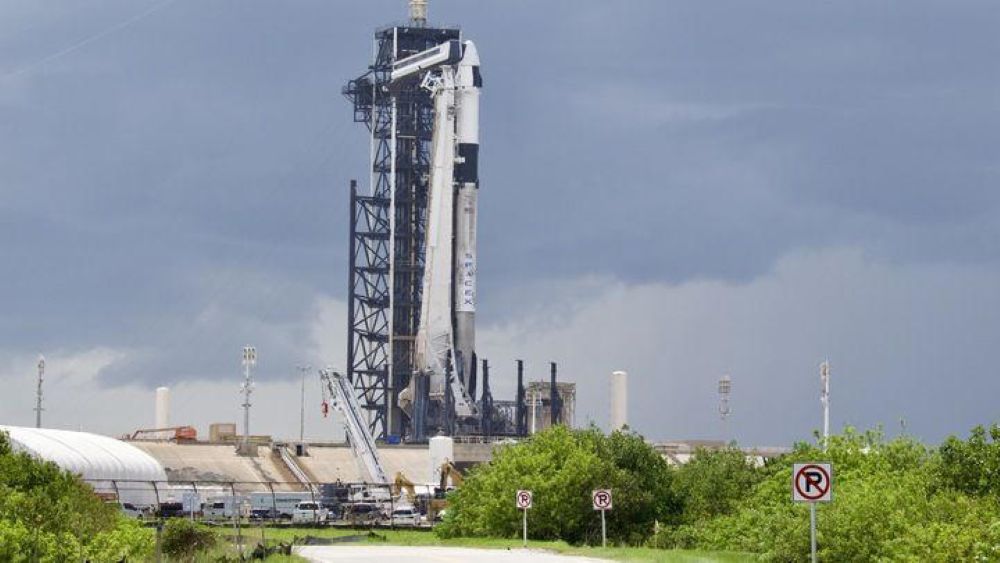

In the last week of June the private Axiom-4 mission was in preparation for launch to the International Space Station, in a Crew Dragon capsule on a Falcon 9 booster (Fig. 1).


The launch was on June 25th (Fig. 2), and the spacecraft and crew returned to Earth on July 15th (Fig. 3). ISS operations continued with the launch of long-stay Crew-11 on August 2nd after a 24-hour delay due to weather. Crew-10, who had been on the ISS since March, separated from it on August 8th in their Crew Dragon (Fig. 4) and splashed down successfully (Fig. 5).


Blue Origin’s New Shepard launches have continued with less publicity than Katy Perry’s flight with her friends in April (Figs. 6 & 7).


Meanwhile the long-delayed second launch of the company’s New Glenn booster is scheduled for some time in August, and remarkably enough it will still be carrying NASA’s twin ESCAPADE Mars probes (Fig. 8), though the ideal launch window for them would have been last November.

Elon Musk’s SpaceX is gearing up for the next launch of the Starship/Superheavy combination on Flight Test 10. Starship-37 was rolled out on July 28th (Fig. 9) and because the static firing test stand was wrecked in the explosion of the previous model (see ‘Space Notes, July 2025′, ON, 29th June 2025), the Starship went straight to the launch tower (Fig. 10), where the static firing was conducted with a single-engine burn on July 31st, simulating the on-orbit restart which SpaceX has yet to accomplish (Fig. 11), followed by a six-engine burn to establish readiness for the launch. Obviously a second explosion would have wrecked the launch tower as well, but if the frequency of launches is to reach Elon Musk’s first target of 25 per year, operations will have to be speedier than they are now.


At first SpaceX said that both static firings had been successful, and the adaptor used for them was removed from the launch tower, but almost immediately it was put back again. Watchers around the Starbase have glimpsed the Starship through the doors of the assembly bay and it’s had scaffolding around it, indicating that some anomaly was found, requiring more work and a further static firing which has still to happen.

The static firing of the FT-10 Superheavy took place back on June 6th (Fig. 12); Elon Musk has said only that he expects the launch some time in August, and warnings to shipping which were previously issued for the week of August 15th to 22nd have been extended to the 28th, so slippage into September seems possible. Meanwhile Musk has said with equal confidence that he intends to launch a Starship to Mars, with a humanoid robot aboard called ‘Optimus’, towards the end of next year.
The situation with media watching Starbase from the outside reminds me of the early days of the space race, when security around Cape Canaveral could be described as ‘patchy’.

The configuration of the Atlas missile was top secret before its first launch in 1957 (Fig. 13), but reporters with binoculars had been able to see through the gantry from locations around the Cape and could describe it as cylindrical and without fins, like the US Navy’s ‘pencil-thin’ Vanguard launcher but more substantial, also unlike the Army’s Redstone-based Jupiter-C.
The general situation remained a contrast with the USSR’s, from where only fanciful artists’ impressions were available until long after the first manned flights in 1961. Supposedly the Sputniks’ upper stages were launched by winged twin-hull carriers (Fig. 14; M. Vassiliev and V.V. Blagonravov, Sputnik into Space, translated via Italian, Badger Books, 1957 – Fig. 15).


An equally fanciful alternative from that book was a blatant rip-off from the painting by Rolf Klep of Wernher von Braun’s design for Across the Space Frontier (Cornelius Ryan, ed, 1952), showing a booster with a huge cluster of Viking engines (Figs. 16 & 17).


Critics including the head of the Viking programme had rightly pointed out how temperamental those were, and the impossibility of clustering them – not realising that the concept was theoretical and von Braun was working in secret on much bigger ideas. Vassiliev and Blagonravov were taking the joke one step further. Each Soviet space ‘spectacular’ was greeted with commemorative stamps issued by every state in the USSR (in my teens, I had most of them), mostly with symbolic or fanciful designs, but as another piece of Russian humour, the ones with the most authentic hardware were from Czechoslovakia – one showing a ‘cosmic rocket’ launcher with four clip-on boosters (Fig. 18).

When the vehicle was finally revealed at the Paris Air Show in 1967, it turned out that instead of developing ever larger engines like von Braun, the Russians had gone for highly reliable low-thrust engines, and the Sputnik booster – later for Vostok and Voshkod, still in use for Soyuz – takes off with 32 engines firing, counting steering jets, on a core stage with four clip-on boosters (Fig. 19).

The principle was taken further with the Lenin booster, intended for Moon landings, with 30 engines which never achieved the reliability needed; and now Elon Musk has revived the concept with the 33 Raptor engines of the Superheavy first stage. On 14th May it was announced that the boosters will be fitted with redesigned grid fins, three of them instead of four, to improve the captures by the launch tower on return to Earth (Fig. 20).

On November 19th 2024 Donald Trump attended the launch of Starship/Superheavy Flight Test 6 with Elon Musk (Fig. 21).

The planned capture of the booster by the ‘Mechazilla’ launch tower arms was cancelled due to a problem with the tower, and the booster splashed down in the Gulf of Mexico (Fig. 22). The President-elect asked if it would be recovered for reuse, but Musk replied that it wouldn’t be worth the cost and effort. In fact it had been tried before: in September 2024, after the FT-4 Superbooster splashed down, the engine ring was recovered (Fig. 23), showing that the inner engines were missing – not surprisingly, since they were firing as they hit the water – and the outer ones were damaged or filled with mud.


The first photo I’d seen was taken from further back and made it seem as if the booster had remained virtually intact, but in the FT-6 splashdown the oxidant tank broke free and floated for two days before sinking. If the booster didn’t explode or break up a full recovery might have been possible, since the hull is stainless steel and would resist corrosion. Speaking at the British Rocketry Oral History conference in 2001, Tom Griffith of the Blue Steel ‘stand-off bomb’ project described how ten rocket-launched models of it, fired in the 1960s from Victor bombers on the Royal Aircraft Establishment’s range off Aberporth, were still somewhere on the floor of Cardigan Bay, “along with ones of Concorde and of supersonic bombers”, and being made of high-quality stainless steel, they should still be in perfect condition if they’re ever recovered. There’s no historical need to do so, since there are several surviving examples (Fig. 24), including one at the Museum of Flight at East Fortune, east of Edinburgh.

On 13th August (our time) the United Launch Alliance’s new Vulcan booster, powered by Jeff Bezos’s BE-4 engines, successfully delivered the Navigation Technology Satellite-3 (NTS-3) to geosynchronous orbit on only its third launch (Figs. 25 & 26).


As the Space Shuttle’s ‘reference mission’ was launching Big Bird spy satellites from Vandenberg Air Force Base (cancelled after the loss of the Challenger), launching the NTS series is similarly what Vulcan was designed to do, though its versatility will allow it to do a great deal more. Launching one so early in development is a sign of the Space Force’s confidence in the system. Described as the first US military navigational satellite for 48 years, NTS-3 is going to test systems including a phased array antenna which will make US forces independent of GPS, once cutting-edge but now increasingly subject to jamming and interference. On August 21st, and probably no coincidence, the Space Force is due to launch its X-37B space plane (Fig. 27) on a mission to test communications and an inertial navigation system which is also to function independently of GPS, but very probably in concert with NTS.

The core of the booster for the Artemis II crewed lunar mission has been mated to the solid boosters in the Vehicle Assembly Building at Kennedy Space Centre, after which the interstage section and the second stage were added. After arrival at the Multi-Payload Processing Facility in May and fuelling for its planned launch between February and May next year, the Orion capsule was moved on August 10th to the Launch Abort System Facility to fit the escape tower to it (Fig. 28). Artemis II is intended to spend a month in lunar orbit, as Artemis I did uncrewed in November-December 2022.


Meanwhile China has conducted uncrewed, tethered tests of its lunar lander Lanyue (Embracing the Moon), with simulated landings and takeoffs from an artificial lunar surface (Fig. 29). The system recapitulated history in several ways: the first fixed-wing Vertical Takeoff and Landing Aircraft, the Short SC-1, was so unstable initially on its downward-pointing jet engine that it had to be tested tethered in a cage, until a fly-by-wire control system was developed for it. NASA later copied its Flying Bedstead prototype for lunar landing simulations, using the jet to cancel five-sixth of its weight, with a throttled rocket motor for the rest. That too was unstable and nearly cost the life of Neil Armstrong (see ‘And Finally… Yes We Did Go to the Moon’, ON, October 23rd, 2022), so using tethers to support most of the weight is preferable.

NASA has finally given up on Lunar Trailblazer, which was launched with the private Athena mission in February and was intended to search for water in possibly ice-filled craters at the lunar south pole (Fig. 30), using a scanner developed by the University of Oxford. Contact with it was not resumed after separation, so it never entered lunar orbit. Nevertheless NASA has continued to try to make contact, in case the problem was simply due to a wrong attitude for its solar panels, but has given up after six months.
On July 30th India launched NISAR (NASA-ISRO Synthetic Aperture Radar) for the most precise studies of land and ice movement to date. On August 13th, NASA announced that its four PUNCH satellites (Polarimeter to Unify the Corona and Heliosphere), launched on April 11th, have now reached their stations in near-polar Sun-synchronous orbit, over the day-night terminator, from which they can produce mosaics of the Solar Wind as it approaches Earth (Fig. 31).

And the same day, at almost the same time as the Vulcan launch and also on a third flight test, ESA’s new Ariane 6 booster launched the Metop-SGA1 weather satellite from Kourou, French Guiana, into polar orbit, and a fuel dump from the returning first stage caused a mild sensation over Canada and the northern US two hours later (Figs. 32 & 33).


Metop-SGA1 will be operated by the international group EUMETSAT (European Organisation for the Exploitation of Meteorological Satellites). The launches were so near simultaneous that I had to watch Ariane 6 on a replay once NTS-3 was on its way.

But despite the initial success of these new projects, the threat remains to NASA’s Earth-monitoring programmes and still more to those of the National Oceanic and Atmospheric Administration (NOAA, Fig. 34), which is another of President Trump’s pet hates because he regards all environmental and weather monitoring as a threat to American big business. On August 4th, the White House issued specific orders to NASA to turn off the Orbiting Carbon Observatory, two satellites mapping carbon dioxide emissions (Victor Tangermann, ‘White House Orders NASA to Destroy Important Satellite’, F, online, August 4th 2025); the Terra and Aqua satellites, with a long track record of Earth observations, are both scheduled for shutting down, along with about 40 other spacecraft – most of them environmental studies, but see below. On July 31st, the Department of Defense stopped passing on storm monitoring data from its last two DMSP (Defense Meteorological Satellite Program) satellites to weather forecasters; their Special Sensor Microwave Imager Sounder (SSMIS) ‘is like a 3D X-ray of tropical storms and hurricanes, revealing where the strongest rain bands and winds are likely to be and how they are shifting,’ with higher resolution and more accurate tracking than NOAA’s satellites can provide.

(Fig. 35; Andrew Freedman, ‘Trump admin will cut forecasters out of key satellite data in one month’, CNN Weather, June 30th 2025; A. Harikrishnan, ‘Pentagon Halts Critical Hurricane Data Feed, Raising Alarm Ahead of Peak Storm Season’, Tech Story, online, June 26th 2025.)
As a postscript to ‘Connecting the Dots’ (ON, 18th May 2025), in which I mentioned the issues of navigating at high fractions of the speed of light, New Horizons has just performed an exercise in interstellar navigation at lower speed. Distances to the nearer stars are determined by measuring their annual parallax, the shift in their position against the background stars as the Earth goes round the Sun. As it’s too small to be perceptible with the naked eye, that was one of the factors which convinced classical astronomers that the Earth had to be stationary (see ‘Ptolemy, The Book of Astronomy in Antiquity‘, ON, 5th January 2025). Even at low fractions of lightspeed, starship navigators would have to be very aware of the changing positions of the nearer stars, in order to check their course and know when to start slowing down. ‘On April 22-23, 2020, when the spacecraft was about 42 AU away, the New Horizons team used the LORRI (Long-range Reconnaissance Imager) camera to image the star fields containing the nearby stars Proxima Centauri and Wolf 359 (Figs. 36 & 37).


At that time, it was the largest such baseline made to that date.’ (Carolyn Collins Pedersen, ‘New Horizons Could Find Its Way to Proxima Centauri If It Wanted’, Universe Today, July 21st 2025.) New Horizons is now at over 62 Astronomical Units away, 62 times the Earth’s distance from the Sun. It is fully operational and its onboard power should last into the 2030s; having imaged Pluto and its moons, and the Kuiper Belt object Arrokoth, it still has enough fuel to undertake another flyby if a target is found, near enough to its line of flight. Around 2027 it should cross the heliopause boundary of the Solar Wind, and that data could be important, because it’s heading in the direction of the Galactic Centre (see ‘Dust Around the Solar System’, ON, 15th June 2025). But it has no contribution to make to a US Moon landing during the Trump presidency, so it too is scheduled for switching off during the great purge of NASA missions to come in October (Fig. 38).

Finally and with regret, we have to note the death on August 7th of Jim Lovell, who flew with Buzz Aldrin on Gemini XII (Fig. 39), flew on Apollo 8 to the Moon in 1968 (Fig. 40), and commanded Apollo 13 on its near-catastrophic rounding the Moon in 1970 (Fig. 41).


I met him in 1984 at the View from Earth symposium in Big Bear Lake, where he was still hale and hearty (Fig. 42), and at age 97 he was still the only man to have been to the Moon twice without landing on it. Seemingly NASA did consider giving him a third try, but he felt that he owed it to other astronauts to stand aside, when the chances for flights were running out.

Duncan’s recent books are available from bookshops or through Amazon; details are on Duncan’s website, www.duncanlunan.com.




Leave a Reply to Duncan LunanCancel reply