
Part 1 – Little Red Dots
So much is happening in astronomy and space nowadays that stories keep having to be moved forward and back, to keep up with even some of the news – hence the mid-month appearance of ‘Space Notes’ for August, last week. No sooner had that been accepted than a new date came in for the second launch of the New Glenn booster, on September 29th, which I added to the article as a Comment; and then one for the FT-10 flight of the Starship/Superheavy combination, which at the moment of writing is scheduled for August 24th, the day this article appears. But even before ‘Space Notes’ publication, two new stories reached my Inbox which are too important to leave to ‘The Sky Above You’ and ‘Space Notes’ at the beginning of September.
When I wrote up the nearer stars and their planets as ‘Pale Red Dots’, and those out to 12 light-years as ‘Beyond the Pale Red Dots’ (Orkney News, 4th and 11th May, 2025), I didn’t make a distinction between them and Little Red Dots, because they’re so different that there’s little chance of confusion.


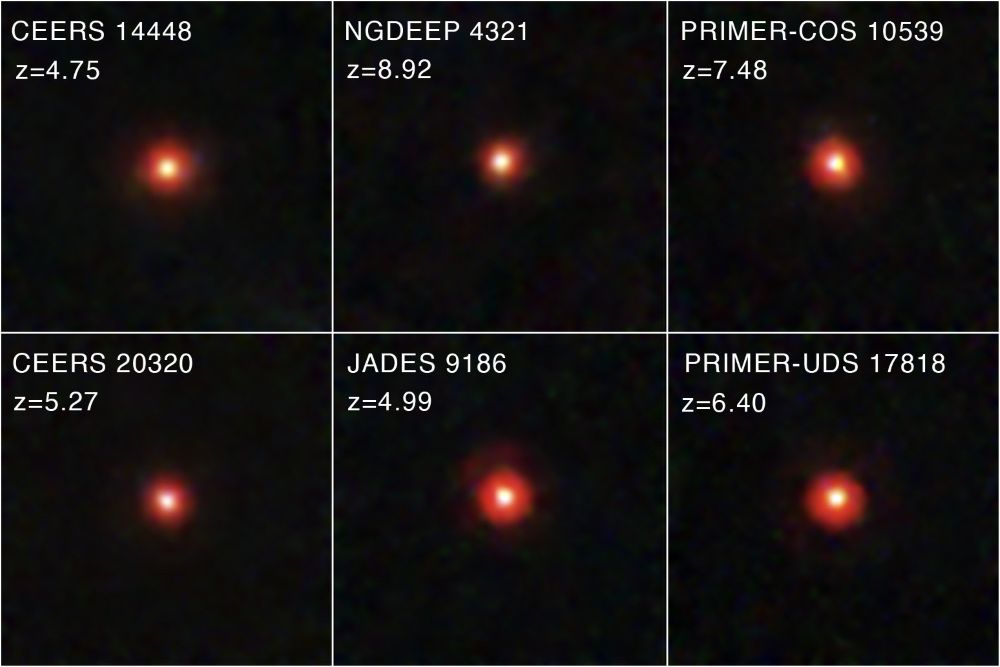
‘Little Red Dots’ are galaxies far out in the early history of the Universe, distinguished by their brightness and colour (Figs. 1 & 2), which have been discovered and studied recently by the James Webb and Hubble Space Telescopes, working in collaboration (of which there’s likely to be less, now that the budgets for both face cutting by 20%). What was particularly surprising were the indications that some of the Little Red Dots might be 3.7 billion years old or more, having formed within 150 million years of the Big Bang and much earlier than any galaxies were thought to exist. As the mystery has deepened I’ve been holding back on reporting it until more was known.
Considerable light has been shed on the problem (literally) by observations of a slightly more recent galaxy, CAPERS-LRD-z9. (‘CAPERS’ is the acronym for the CANDELS-Area Prism Epoch of Reionization Survey.) It’s 13.3 billion light-years away, putting its origin less than 500 million years after the Big Bang, and within the period up to 600 million years in which Little Red Dots are found. (Matthew Williams, ‘Astronomers Spot the Earliest Confirmed Black Hole at Cosmic Dawn’, Universe Today, August 9th 2025). Its central black hole has 300 million times the mass of our Sun, which isn’t abnormal – our Galaxy’s supermassive black hole has 4.3 million solar masses, and a black hole with 36 billion solar masses has been discovered only recently (Collins Eshiet, ‘The Most Massive Black Hole Ever Detected: 36 Billion Times the Sun’s Mass’, Orbital Today, online, 12th August 2025) – but its existence so early is truly surprising. It cannot be due to mergers of stars, not even the massive ‘pressure-cooker’ stars which were the first to form (see ‘Beginners’ Astronomy: Galaxies, Part 1′, ON, February 27th, 2022).


It must have been formed by mergers of ‘intermediate black holes’ (Figs. 3 & 4), between the masses of stars and of the present supermassive black holes at galactic centres, and for those to have formed so early, they must have been generated by collapse of gas clouds rather than stellar collisions (Fig. 5).

That idea has been around for some years, without supporting evidence, but as supermassive black holes are found earlier and earlier, it seems unavoidable.


At one stage WIMPS (Weakly Interacting Massive Particles) were thought to have played a part, either in forming ‘Dark Stars’ or in direct collapse (Figs. 6-8), but as WIMPS have been ruled out as constituents of dark matter, the Cosmic Web of dark matter itself may have pulled the early gas clouds into collapse (Fig 9).

To add to the surprise, the red colour of CAPERS-LRD-z9 and older objects is apparently due to huge volumes of dust surrounding them (Fig. 10), again very surprising at such an early stage in the history of the Universe, which is having to be extensively rewritten.

When I was a student in the mid-1960s, much of the latest and most mysterious news concerned the discovery of quasars, ‘quasi-stellar objects’, which were very powerful optical and radio sources in the early Universe, several billion years after the Big Bang. Fred Hoyle (later Sir Fred) was one of the first to realise that only gravitational collapse of supermassive objects could supply the energies needed, an idea which he used in an encounter with a quasar in his novel (with Geoffrey Hoyle), Into Deepest Space (Penguin, 1977).

It had been thought that quasars might have formed even before the ‘reionisation event’ when the Universe became transparent (Fig. 11), but now it seems that Little Red Dots have to be seen as the precursors of them, or ‘seeds’ as they’re being called (Matthew Williams, above). It seems that the Web may have formed in the early Universe due to baryon-acoustic oscillations, actual echoes of the Big Bang (see ‘The Sky Above You, August 2025′, ON, 31st July 2025).


In Fig. 12 the strands visible, midway between the Web and the spiral galaxies, are lit by quasars (Fig. 13), subsiding into active galaxies in the next 2 billion years (Fig. 14). So it seems that the Little Red Dots are providing the missing link which gives us an evolutionary sequence, from the baryon-acoustic oscillations to the formation of the Cosmic Web, through to the Little Red Dots, through quasars, through active galaxies, to the ‘normal’ galaxies of today – the remaining mysteries are how its early stages all happened so fast, and, perhaps, why the recognition of it hasn’t made more news than it has.
Part 2 – Interstellar Comet, continued

At the other end of the cosmic scale, and since ‘Pale Red Dots’, ‘Beyond the Pale Red Dots’, and the August ‘Sky Above You’, I wrote up the new Solar System visitor 31/ATLAS (Fig. 15) as ‘Interstellar Comet’ (ON, 9th August 2025). A succession of garbled quotes in the media from Prof. Avi Loeb have suggested that it could be cover for another object sneaking up on us behind Mars, Venus and Jupiter. Actually it’s going to pass Mars at 1,860,000 miles, and when it comes from behind the Sun in December, it will be close to Venus in the sky but nowhere near it in space. And it will pass Jupiter at 33.25 million miles on its way out of the Solar System (Fig. 16), which is not much good for concealment.

But Prof. Loeb, who suggested that the first interstellar visitor, ‘Oumuamua, might be a spacecraft (‘Oumuamua’ Part 1 & 2, ON, 24th and 31st December, 2023), and the new one might be, has now come up with a truly remarkable way to find out, or at least to study what may be a 9-billion-year old comet from the galactic disc. (Matthew Williams, ‘NASA’s Juno Spacecraft Could Intercept 3I/ATLAS as it Approaches Jupiter’, Universe Today, August 13th 2025. Here too, ‘approaches’ means close in the sky, not in space.)


The Juno spacecraft, launched in 2011, reached Jupiter in 2016 (Figs. 17 & 18) and has been in 53-day orbit over the poles of the planet, making many discoveries since, including the depth of the Great Red Spot (Fig. 19), the height of lightning storms (Fig. 20), the absence of any solid core within the planet, and the presence of huge, semi-permanent cyclones at both poles of Jupiter (Fig. 21).


Originally it was to have dropped into a lower 11-day orbit and after closer studies of the planet, accumulating a higher dosage from Jupiter’s radiation belts, it was to descend into the planet in 2018 (Figs. 22-24).


Due to a potential problem with the propulsion system, NASA decided to leave it in higher orbit and extend the mission to September 2025 at least (Fig. 25), allowing the close flybys of the Galilean moons (2 of Ganymede, 3 of Europa and 11 of Io, on which I’ve been reporting as they happened. (See for example ‘The Sky Above You, March 2024′, ON, 2nd March 2024).

Juno’s instrumentation is still working perfectly, but after 9 years, 7 years longer than planned, no further extension was planned and it is decisively on the Trump administration’s list for shutting down, as one of the first spacecraft to do so on September 17th. Instead Prof. Loeb and his colleagues have suggested a deceleration burn on September 8th, similar to the one originally proposed (Fig. 23), and then an ‘Oberth manoeuvre’ to reverse its approach path and send it out to meet 31/ATLAS on March 14th 2026. In what they term a ‘zero-distance approach’, all of Juno’s instruments, including its near-infrared spectrometer, magnetometer, microwave radiometer, gravity science instrument, energetic particle detector, radio and plasma wave sensor, UV spectrograph, and visible light camera (Fig. 26), would be deployed for a really detailed examination of the target.

The only objection I have seen raised is that Avi Loeb was still taking the diameter of 31/ATLAS to be 20 km, but more recent Hubble measurements suggest a maximum of 5 km, possibly as low as 32 metres. Why being smaller would reduce the scientific value of a body which may be 9 billion years old, from the upper region of the Galaxy’s ‘thick disc’, or may just possibly be artificial (see ‘Interstellar Comet’ last week) frankly baffles me. Indeed, if it is so small, it must be at least as highly reflective as ‘Oumuamua was, and that would increase its importance, whatever its nature. A further mystery, making it still more intriguing, is that it’s not developing a gaseous coma and tail like normal comets (including Comet Borisov, the second interstellar object to pass us recently), but is instead pushing out a forward dust cloud, whose brightness is not falling off with distance as would be expected. Avi Loeb has suggested, not entirely tongue-in-cheek, that it may be self-luminous. ‘And if that may not be’, to quote Robert Burton, then we might have to think of the dust shield which was intended to precede the British Interplanetary Society’s Daedalus vehicle (Fig. 27; see ‘Pale Red Dots‘). Admittedly that was intended for passing through a planetary system at 12 percent of lightspeed, but 31/ATLAS’s hypothetical makers might not have foreseen an encounter as slow as this.

The only other objection which could be raised, as far as I can see, is that if the departure burn fails, Juno could be left in a tighter orbit around Jupiter, increasing the chance of a collision with one of the Galilean moons. Contaminating the fiery surface of Io is not likely to be a problem, but with Ganymede and particularly Europa it’s more to be avoided, given the possibility of life in their interiors. That said, Juno doesn’t have a radioactive power source like earlier probes to the outer planets, instead using newer and more effective solar panels (Figs. 17 & 18), so any debris would remain on the surface of the moon affected and wouldn’t melt its way down into the ocean below.


Juno’s problematic engine is the British-built Westcott Leros 1 (Figs. 28-30), which had an excellent previous track record, having been used with no problems on the Messenger Mercury orbiter in 2011, before that Mars Global Surveyor and Mars Odyssey, and the NEAR-Shoemaker asteroid probe. But on October 14th 2016, on the second orbit of Jupiter, telemetry indications were received that the helium valves pressurising the fuel tanks weren’t opening properly for the orbit reduction burn. Four days later the spacecraft put itself into safe mode due to unexpected issues, and once full contact was regained, the controllers decided not to risk a major manoeuvre in case it ended up in ‘a bad orbit’, losing all further data.
Trying it now would be a risk, but sometimes valve problems are solved. The near-loss of the Atlas prototype MX-774 springs to mind (John L. Chapman, Atlas, the Story of a Missile, Gollancz, 1960), and there was a similar issue immediately before the launch of the first Artemis booster in November 2022. Sometimes stuck valves solve themselves, like the first air-launch of the Douglas Skyrocket (William Bridgeman, The Lonely Sky, Cassell, 1956). But then again, Neil Armstrong and Dave Scott had a major problem with a jammed thruster on Gemini VIII, and the Mars Observer suddenly lost contact as its engine was being pressurised for its Mars approach in 1993. Both ESA’s BepiColombo mission to Mercury and NASA’s Psyche mission, to the asteroid of the same name, are having trouble with fuel feeds in their ion-drive systems. If the attempted Juno restart goes wrong, the maximum loss will be 8 days of Jupiter data, when we already have so much; but if it succeds, we stand to gain data of huge value if 31/ATLAS is natural, and beyond measure in value if it isn’t.
Duncan Lunan’s recent books are available from bookshops and through Amazon; details are on Duncan’s website, www.duncanlunan.com.

Leave a Reply