
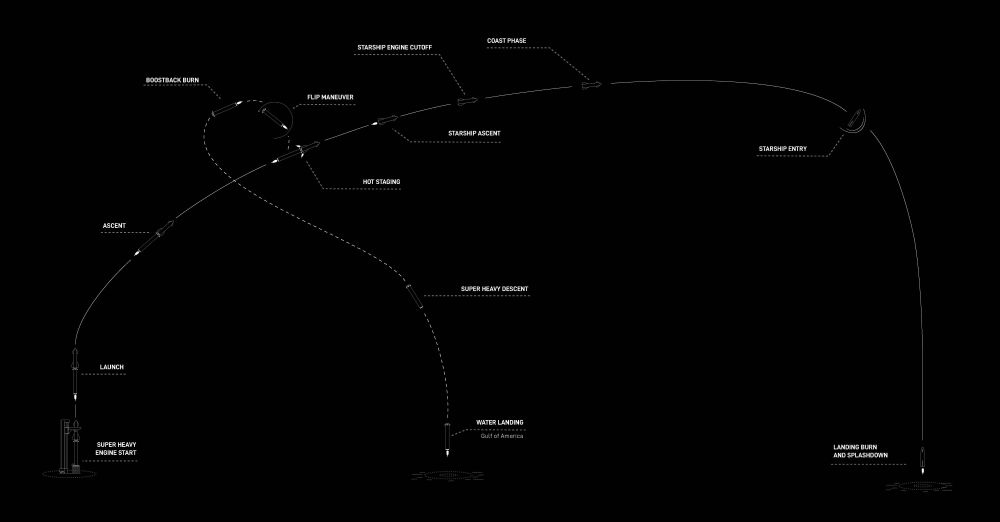
The 11th test flight of the SpaceX Starship/Superheavy combination took place on October 13th, and was a complete success, putting the previous almost successful FT-10 mission in the shade. The one thing that didn’t go 100% to plan was the descent of the Superheavy booster into the sea, during which one of the engines failed to relight as planned – but it was promptly replaced by another, which was one of the things the flight was intended to test, before captures by the launch tower resume. It had emerged that on FT-10 there was a small external fuel explosion, which damaged the skirt of the Starship engine bay, but this time the on-orbit relight test went perfectly. So did the release of dummy Starlink satellites, which had shown a noticeable wobble during deployment on FT-10, but this time came out straight and level. Finally and perhaps most importantly, this time there was no burn-through on the fins, even when the Starship tested its cross-range capability during re-entry by veering off course and returning to it, splashing down within view of the camera buoy at the target landing site, once again.

The one oddity seems to be that whereas last time I was able to locate a complete set of photos covering the flight profile (Fig. 1; see ‘Space Notes, September 2025’, ON, 31st August 2025), this time, although there are plenty of videos online, there seems to be a dearth of still photos except for the liftoff (Figs. 2 and 3) and the final descent (Fig. 4).


There is now expected to be a pause in Starship launches until February next year, during which the launch tower will be modified to take longer versions of both Starship and Superheavy, with more powerful versions of the Raptor engines. I have seen some criticism of the management practise here, arguing that the critical path analysis should have brought all these elements together for an immediate transition, but given the delays there have been, and the problems which have been encountered and surmounted, that doesn’t seem to me fair comment. If there is any breathing space in the breakneck speed of development, I suspect that the designers and engineers may be glad of it. What I have not seen after FT-11 is any repeat of the ‘Starship will never work’ articles I remarked on in the October ‘Space Notes’ (ON, 5th October, 2025). When they are ready to fly again, I expect events to be spectacular.


Meanwhile the second New Glenn booster, brainchild of the Blue Origin company, is preparing for launch on November 9th, as this article appears, after a successful static firing on October 30th (Figs. 5 & 6). The booster, named Never Tell Me the Odds, is carrying NASA’s twin ESCAPADE Mars Probes, and is intended to be recovered by the Jacklyn barge named after Jeff Bezos’s mother (Figs. 7 & 8).


Blue Origin intends to establish a vertical refurbishment facility near the launch pad at Pad 36 of the former Cape Canaveral Air Force Station (Fig. 9).

The first one, So You’re Telling Me There’s a Chance, failed to land because its engines didn’t relight. Blue Origin plans to launch its Blue Moon Mark 1 uncrewed lunar lander on NG-3 (Fig. 10).


On October 19th the Orion capsule Integrity was mated to the Space Launch System booster (Fig. 11), so the launch vehicle is now fully stacked for NASA’s Artemis II mission, scheduled to launch to lunar orbit on February 5th, 2026 (Figs. 12 & 13).


Possible delays to the 2027 Artemis III mission, on which Artemis is to rendezvous with a Starship for descent to the lunar surface (Fig. 14), have led to a call from Sean Duffy, the pro-Trump Acting Director of NASA, for possible alternative methods of getting there before the Chinese – which he has already declared to be NASA’s only purpose.

Both SpaceX and Blue Origin have responded, but as far as is known the only alternative lander is the crewed version of Blue Moon, currently scheduled for launch on New Glenn to rendezvous in lunar orbit with Artemis 5. China’s Mengzhou spacecraft is to begin flight tests next year, and tether tests of the Lanyue lander began in August (see ‘Space Notes, September 2025′, ON, 31st August 2025).

The ‘Roadmap of China Lunar and Deep Space Exploration’ published last year (Fig. 15) shows the crewed lunar landing by 2030, after two more uncrewed landings, but it could be a great deal sooner. Elon Musk replied to Duffy online saying he knew nothing about space or rockets, and Donald Trump appears to agree, re-proposing Jared Isaacman for NASA Director despite the Democrat convictions for which Trump rejected him last time. To paraphrase Stanley Holloway (and only by changing tense), ‘the whole daft thing is kind of a jam’.


The third launch of ESA’s Ariane 6 booster was on November 4th (Figs. 16 & 17), and has completed the flight qualification of the vehicle, after the successful launch of the CSO-3 satellite on March 6th, 2025. Sentinel 1-D was released 35 minutes after launch, to replace the ageing Sentinel 1-A and continue radar observation of weather systems, working with Sentinel 1-C. Because of advantages of its near-equatorial launch site, Ariane 6 can now be expected to pick up a substantial number of launch contracts, after the delays which followed the end of the Ariane 5 programme in 2023.

Delays have also affected the only private spaceplane currently in contention, Sierra Nevada’s Dream Chaser (Fig. 18). Although it lost the initial competition for cargo supply to the International Space Station, when contracts were placed with SpaceX and with Orbital Science Corp’s Antares, NASA later booked seven cargo launches to the ISS with Dream Chaser. But because of the delays, and with the end of the ISS looming in 2030 or sooner, NASA has now modified the agreement to commit Sierra Nevada only to an on-orbit demonstration next year. If that is successful, further demonstration flights to the ISS will be required. But the ISS isn’t the only potential destination for Dream Chaser. On November 2nd a ‘Bandwagon’ SpaceX launch from Kennedy Space Centre, with 18 payloads (Fig. 19), put up the Haven Demo, to test critical systems including propulsion, flight computers and navigation software, for Haven-1, the first component of the first private space station, which VastSpace intends to launch in the second quarter of next year (Fig. 20).


In September it became clear that the interstellar object 3I/ATLAS would not be intercepted by the Juno spacecraft, as Prof. Avi Loeb had suggested it might, and I commented on (‘Interstellar Comet‘, ‘Little Red Dots and Interstellar Comet’, ON, 10th & 24th August, 2025). I’ve deliberately said little about it since, until ‘The Sky Above You’ earlier this week, while waiting for the long-distance view to become clearer. There has been a great deal in the media meantime, much of it highly misleading, on both sides of the controversy. On what might be called the ‘conventional’ side, the claim that it’s ‘just an ordinary comet’ has had a great deal of airing, continuing to repeat the early misidentification of gases normally found in comets such as water vapour and cyanogen, by those determined to force 3I/ATLAS into a known category of object, as previously happened with the first interstellar object to be detected (see ”Oumuamua, Part One’, ON, 17th December 2023). Fraser Cain, the Editor of Universe Today online, is to be commended for articles such as ‘NOT a Typical Comet’, pointing out the ways in which it isn’t, and calling for a more open-minded approach. Meanwhile Avi Loeb has kept up a steady stream of posts on an online source called Medium, updating the facts as they come to hand (and throwing in the occasional provocative suggestion). Medium is not generally available except on subscription, but Prof. Loeb was kind enough to put me on the mailing list for his posts after I sent him the first two articles.
During its approach to the orbit of Mars 3I/ATLAS became considerably brighter than expected, despite not growing a gaseous or ion tail as most comets do (though a short ‘antitail’ did finally appear not long before its disappearance). First it built up a forward cloud of dust and gas containing a high proportion of carbon dioxide, a very small amount of water, and great deal of powdered nickel – often found in metallic asteroids, but in company with iron, as it is in the Earth’s core. The brightness and the solo presence of nickel prompted Avi Loeb to suggest that the metal might have been industrially refined, and the object might have an artificial light source. A colleague of mine remarked that it was unlikely to be releasing dust, but I countered that if it really is 7 to 9 billion years old, as its orbit suggests, it may have suffered a great deal of erosion. On that subject a detailed search of the latest stellar catalogue from the Gaia space telescope (see ‘The Sky Above You, February 2025’, ON, 1st February 2025) has failed to identify even one candidate star for 3I/ATLAS’s origin, implying that it is indeed of great age.

In the approach to Mars (at several million miles, Fig. 21) 3I/ATLAS acquired a prominent blue colour, as well as a stronger green band in its spectrum, with the first trace of cyanogen to be detected (Fig. 22).

When I observed Comet Bennett in 1970 its halo was brilliant blue, shot through with diffraction spikes (inspiring my most successful short story), but that was because the comet had a very large water content, which 3I/ATLAS definitely has not.
Because of its brightness, as it passed Mars 3I/ATLAS was imaged by several spacecraft on or orbiting the planet. The first image by the Perseverance rover on the surface was misinterpreted as showing the comet to be cylindrical, but not only was it a time exposure, it actually showed Phobos, the inner moon (Fig. 23).

ESA’s Trace Gas Explorer has captured it as a blob (shown in The Sky Above You) and China’s Tianwen-1 has done the same (Fig. 24), but neither tells us much.

Images from Mars Reconnaissance Orbiter have not yet been released due to the US government shut-down, and conspiracy theorists are having a field day with that, but Prof. Loeb’s Congressional backers are fighting to get them out.

While 3I/ATLAS has been out of sight, a supposedly recent image has appeared with a headline saying that it shows a ‘terrifying’ jet pointing towards the Sun, and so the object is indeed thrusting towards Earth (Fig, 25). Actually sunward thrust wouldn’t bring it to Earth, for astrodynamical reasons, and the image shows a feature which is often seen in the heads of comets, if not exactly ‘typical’, where diffraction creates the appearance of a sunward jet which isn’t there. Comet Arend-Roland (1957), the first comet I ever saw, had one which bemused Patrick Moore at the time (Fig. 26).

Shortly before 3I/ATLAS was lost to view from Earth, it was photographed by a spectrograph on the GOES-19 weather satellite in geosynchronous orbit (Fig. 27).


A dramatic image but an unhelpful article (Fig. 28) showed four spacecraft (Solar Orbiter, STEREO-A, BepiColombo and SOHO) supposedly engaged in ‘meticulous analysis’ of gases in the tail, which would be very useful if true. Indeed, the tail is pointing away from the Sun and it might impinge on spacecraft with a view like Fig. 27’s, but BepiColombo and Solar Orbiter are passing through inward of it, STEREO-A is in solar orbit at the same distance as the Earth which the comet will never cross, and SOHO is only a million mile away at the Sun-Earth L1 point, very little better. None of them has the right instrumentation for ‘meticulous analysis’. Prof. Robert Farquhar redirected International Sun-Earth Explorer to pass through the tail of Comet Giacobini-Zinner in 1985, but it could only take magnetometer readings, valuable as those were (Figs. 29-30).


SOHO, STEREO-A and PUNCH have all now imaged the comet near the Sun (Figs. 31 & 32), and it should now be in the field of ESA’s JUICE mission (Fig. 33), but the only surprise to date is that 3I/ATLAS may be slightly out of position, when relativistic effects are taken into account (Avi Loeb, ‘Post Perihelion Data on 3I/ATLAS’, Medium, 5th November 2025.) What significance that may have remains to be seen.

‘The Comet, the Cairn and the Capsule’ by Duncan Lunan, with notes on Comet Bennett, appears in his collection From the Moon to the Stars (Other Side Books, 2019). That and his other recent books are available from bookshops and through Amazon; details are on Duncan’s website, www.duncanlunan.com.


Leave a Reply