
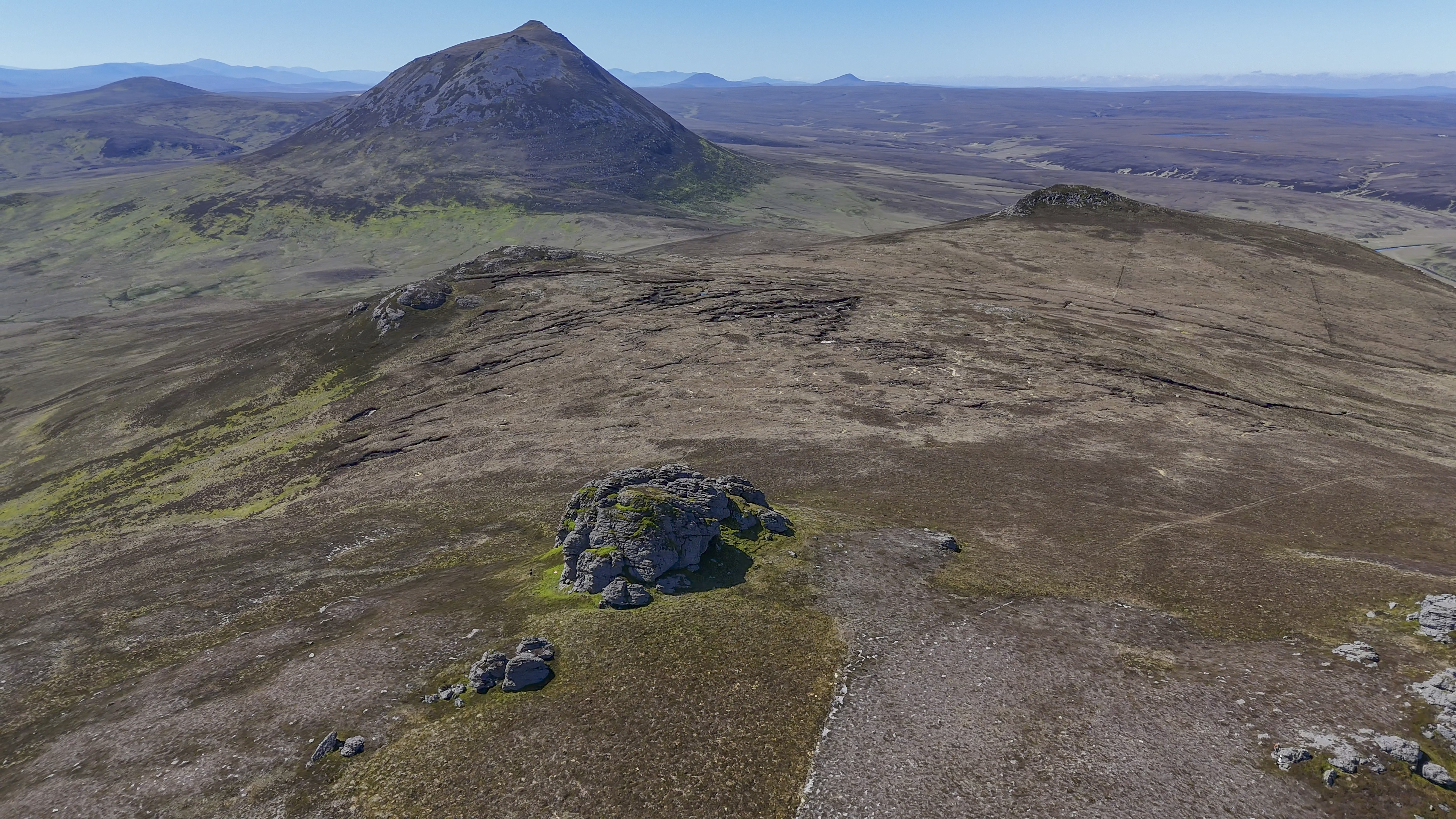
A new film from the north of Scotland has been put online, showing the immensity of geological time through the landscapes of Caithness and Orkney. Its aim is to visualise the vastness of tens and hundreds and millions of years through which mountains gradually rise and erode; and filmmaker Selena S. Kuzman’s stunning aerial images range from the mountains of Morven, Scaraben and Smean in Caithness to Orkney’s Brinkie’s Brae, once a granite island in a great mid-continental lake.

The story was developed by Edinburgh-based geologist Dr Adrian Hall who wanted to find a way to bring out the scale of deep geological time. Assisting him on the journey are Katy Firth from Orkney and Mara Gibb from Caithness, and along the way they develop images of timelines – including the miles of an A9 journey from Helmsdale that extends south to Land’s End and across land and sea as far as Timbuktu.

They end at Orkney’s red sandstone cathedral of St Magnus, with rising height up its walls providing a further scale of geological time. Orkney storyteller Tom Muir provides a welcome there and also an initial voiceover for the film
They hear on their travels about methods of dating ancient rock that have shown that the tors on Smean are the oldest rock surfaces in the British Isles.


They find everywhere signs of the mighty Caledonian mountains, at one time of Himalayan proportions and then through erosion the source of the sediments that would form the Old Red Sandstone. They learn of yet more ancient mountains, whose metamorphosed fragments form the oldest rocks we can see today, like the Scaraben quartzite, a connection to a lost landscape that the long processes of geological time have erased entirely away.

On Shapinsay in Orkney they see the debris from the melting of an Ice Age glacier, and the marks of a lava flow from a far-off time; and they get a closer look at its nature from rock slides in the Ted Kellock collection in Stromness Museum. In Caithness they visit Dunnet Bay to look at a younger and changeable landscape of sand and dunes.
Apart from a local premiere to an audience in September’s Orkney International Science Festival, the film has not yet been available for public viewing. It was released for St Andrew’s Night, looking ahead to next year’s 300th anniversary of the birth of James Hutton, the East Lothian geologist and farming landowner who developed the whole concept of deep geological time. Before his discoveries, the picture of the earth’s past was a short one of 6,000 years since creation.
Hutton revolutionised the understanding of the past by showing that the rocks around us are built up of long slow geological processes which we can see in action today.

The film is part of a long-term vision for the understanding of northern geology and landscape developed by Dr Adrian Hall along with his friend and colleague in Orkney, the late Dr John Flett Brown. The two developed Caithness and Orkney Landscapes websites, for which they brought in a fossil fish expert, Dr Jan den Blaauwen of the University of Amsterdam, and previous films such as The Making of the Pentland Firth.

The Science Festival has provided back-up and sought funding to make possible a big redevelopment of the Landscapes sites by Selena S. Kuzman. As Old as the Hills was made possible through the support of EventScotland.
Howie Firth.
Previous films from 2024
The Making of the Pentland Firth
https://youtu.be/CaGCmTAfF98
Stroma – Island of Storms and Tides
https://youtu.be/FBXNABvqJJk
Living by the Pentland Firth: Tides, Storms and People
https://youtu.be/b6_9osWYeBc




Leave a Reply