
I’ve twice delayed this column, substituting other topics, because the Polaris Dawn space mission was put back. On its original schedule it was to have been launched on a Monday for five days in space, so I could have covered it from liftoff to splashdown, but that was not to be, and for various practical reasons I’m covering its first four days now.
Polaris Dawn is the first of three such missions financed by the billionaire Jared Isaacman, whose first private spaceflight was Inspiration4, using the SpaceX Crew Dragon capsule launched by Falcon 9 booster. Inspiration4 flew in 2021, and other private missions have since been flown by Axiom Space, in 2022, 2023 and 2024, and there is a serious likelihood of an all-British one (see ‘Space Notes’, ON, January 14th 2024). The third Polaris Dawn mission is intended to be flown on SpaceX’s Starship/Superheavy combination, with the possibility of a Moon landing.

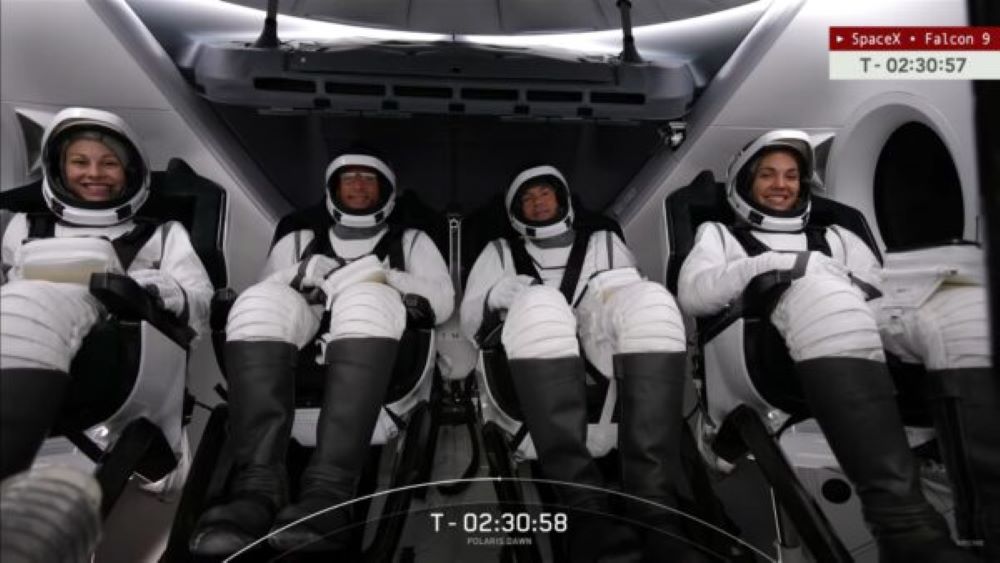
After the delays, Polaris Dawn took off with four astronauts (Fig. 1), including Isaacman himself for the second time, on September 10th from Kennedy Space Centre (Figs. 2 & 3).


After separation the first stage landed successfully on the Atlantic drone ship (Fig. 4) and after the second stage burn and separation (Fig. 5), a thruster burn (Fig. 6) took the Resilience capsule to its peak altitude (apogee) 870 miles (1400.7 km) from Earth (Figs. 7 & 8), penetrating the Inner Van Allen Radiation Belt. This was the highest any humans had been since the departing and returning Apollo missions, and before that Gemini 11 in 1966.


A great deal has been made of that, rightly enough, but I wonder how many people have any clear idea of what Project Gemini was? I recall young adults, only 10 years younger than myself, with whom it hadn’t registered, or who had forgotten it by the time of the last Apollo mission in 1975, less than a decade later, and thought US spaceflight had begun with the Moon landing.
After the creation of NASA in 1958, in response to the shock of the Soviet Sputnik triumphs the year before, one of the crash programmes to catch up raised a minor proposal called Man-in-Space to the status of Project Mercury, a series of six one-man spaceflights. After Alan Shepard’s first sub-orbital flight in 1961, John F. Kennedy declared the aim of putting men on the Moon and returning them safely to Earth before the decade was out. It was a very ambitious goal and to bridge the gap between Mercury and Apollo NASA needed another crash programme of two-man spacecraft, Gemini, to gain experience with multi-man spacecraft, rendezvous and docking, extra-vehicular activity, etc. (See ‘History of Spaceflight’, ON, October 16th 2022.) The 9 crewed Gemini missions accomplished all of that and much more.
Rather than using purely passive docking targets like Gemini 5’s, for missions after the Gemini 6 & 7 rendezvous NASA went for more ambitious link-ups with unmanned Agena boosters. The first of these and the first docking, Gemini 8, turned into a crisis when one of its thrusters jammed on, and Neil Armstrong and Dave Scott had to make an emergency return to Earth. Gemini 9 was unable to dock because the Agena shroud failed to release, and the first burn of the Agena engine with Gemini attached was on Gemini 10 (Fig. 9).

The first full test of the capability was with Gemini 11 in September 1966, when the Agena took the capsule to a height of 835 miles, viewing the whole Indian subcontinent including Sri Lanka (Fig. 10), and much of Western Australia (Fig. 11).


The exercise was partly a test of the Earth Orbit Rendezvous technique for reaching the Moon, which would have required two Saturn C-3 boosters (Fig. 12), instead of the more powerful Saturn C-5 (Saturn V) which had already been chosen for Lunar Orbit Rendezvous.

On Polaris Dawn’s Day 1, the crew began pre-breathing exercises, flushing nitrogen out of their blood to reach 100% oxygen for the space suited EVA experience. On Day 2, the Dragon was lowered to its ‘cruising orbit’ of 450 miles (730 km) and on Day 3, first Jared Isaacman and then Sarah Gillis climbed most of the way out of the open top hatch using a ladder called the Skywalker (Figs. 13-18). The spacewalks were delayed while preparations were completed and unfortunately Sarah Gillis’s seems to have been mostly in darkness.


There has been criticism of the mission, with claims that it is no more than a stunt, an ego-boost for Isaacman. That can at least partly be answered by booking at its altitude relative to other missions (Fig. 19).

Even Inspiration4 performed biometric tests and brought back samples to add to the database of human responses to spaceflight, but Polaris Dawn is continuing that with much better instrumentation than Gemini 11 had, 36 experiments from 31 different institutions. In particular, the data on radiation exposure and the body’s response to it will be especially valuable because it will be acquired with the same instruments that are used on the International Space Station, the first time that has been done, and the exposure on the first few orbits was equivalent to three months on the ISS. As one scientist said, in mapping the Earth’s radiation environment, “at last we shall be able to compare apples with apples” at higher altitudes. The practical results will also be valuable, particularly to see how effective the new spacesuits used (Fig. 20) and the capsule’s insulation are, in proximity to the Inner Van Allen Belt, exploring that region for the first time.

Another point not be sneezed at is that both Inspiration4 and Polaris Dawn are part of Isaacman’s personal campaign to support the St. Jude Children’s Hospital in Memphis, Tennessee, which is dedicated to fighting childhood cancer. Inspiration4 raised over $200 million for the hospital. Hayley Arcenaux, one of the Inspiration4 crew, visited the hospital after the mission and met Liv Perroto, a cancer survivor whom the Polaris Dawn crew invited to design their zero-g indicator, by tradition a tethered toy animal which indicates to the crew and to the ground that propulsion has ceased (Fig. 21). Sean the Sheep flew in that role around the Moon on Artemis 1. Liv Perroto has designed ‘Asteroid’, a plush Shiba toy based on Elon Musk’s dog Floki (Fig. 22). Replicas are available from SpaceX at $25, with proceeds going to the hospital.


By Day 4 of the mission, as I write the crew are dealing with less serious matters. They have communicated with the ground using X via Starlink satellites (Fig. 23), which may not be trivial in the long run; and Sarah Gillis has sent back a video of a violin solo, ‘Rey’s Theme’ by John Williams for Star Wars: The Force Awakens (Fig. 24), following in the tradition of a ukulele solo on Inspiration4 and Chris Hadfield’s version of Space Oddity at the end of his last tour on the ISS.


Meanwhile, there have been complaints on social media that the spacewalks were ‘boring’, and the astronauts should have got completely out into space, as Alexei Leonov did on Voshkod 2 and Ed White did on Gemini 4. The complainers might be put in touch with those who say it’s just a stunt. There is a tradition of such responses: the original Star Trek studio used to do it with people who complained about the composition of the Enterprise crew, wanting more or fewer of this group or that. (Stephen E. Whitfield & Gene Roddenberry, The Making of Star Trek, Ballantine, 1991.) NASA has been known to do it, at least unofficially, with people who insist the astronauts met aliens on the Moon, and people who insist that the Apollo landings never took place.


There have even been suggestions that Isaacman’s and Gillis’s spacewalks weren’t true EVAs because they didn’t get right out of the spacecraft. The obvious reply is that on Apollo 9, Dave Scott and Rusty Schweickart photographed each other from the Command Module and Lunar Module, but both remained within the hatches because there was no reason to do more (Figs. 25 & 26). On Apollos 15, 16 and 17, on the way home, one astronaut retrieved tape cassettes from the Scientific Instrument Modules on the Service Modules, passing them back to another who stood in the hatch to receive them (Fig. 27). In all five cases the spacecraft was depressurised, all the occupants were spacesuited, and nobody has suggested those weren’t EVAs. In the present case, the object was to test the flexibility of the new spacesuits, with no need to risk drifting around. With the complaints of this and the previous paragraph, the best reply is an Arabic proverb which was a favourite of the late Chris Boyce: ‘The dogs bark, but the caravan moves on’.

While we await the return of Polaris Dawn on Sunday, the Federal Aviation Authority has announced that the next launch of the Starship/Superheavy combination can’t take place till late November at the earliest. Seemingly the issue is that after the Ship 5 launch Elon Musk intends to catch the booster on return to the launch tower, and to keep doing it thereafter. His forthright reply is scarcely politic, given that the FAA cleared his Falcon 9 to resume flights only two days after a collapsed landing leg destroyed SpaceX’s oldest booster. But his frustration is understandable, given that catching the Superheavies has always been the intention. There were suggestions that it might be tried on the 4th launch, and a rehearsal was synchronised with that booster’s splashdown. Ship 5 is ready to launch, so why is a long environmental review needed at this stage?
Duncan Lunan’s more recent books are available on Amazon; for more details see Duncan’s website, http://www.duncanlunan.com.

Leave a Reply to Polaris Dawn 2 – The Orkney NewsCancel reply