
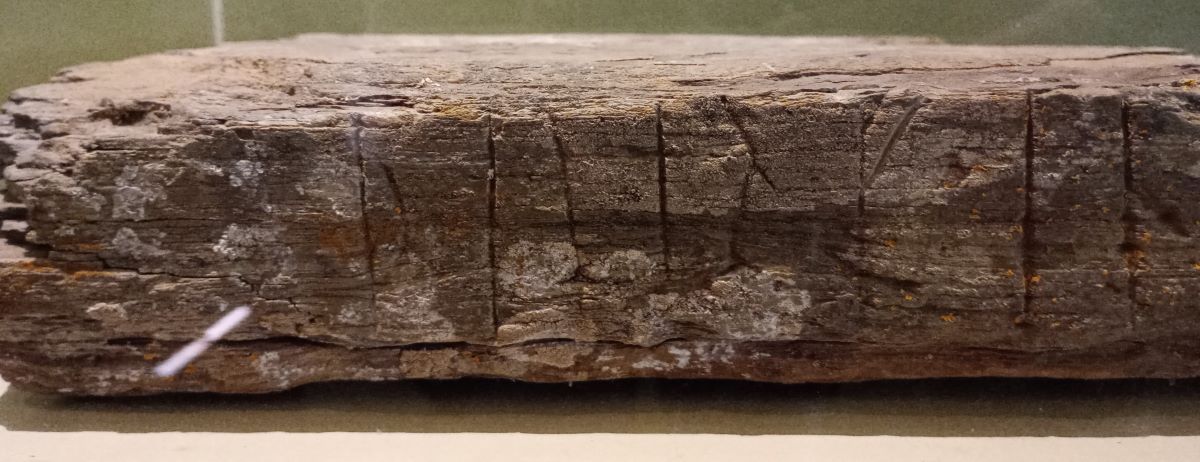
The highest density of Norse runic inscriptions in Scotland are in Orkney. But what can the runes tells us about the people who carved them ?
What are runes?
“Runic alphabet, also called futhark, a writing system of uncertain origin used by Germanic peoples of northern Europe, Britain, Scandinavia, and Iceland from about the 3rd century to the 16th or 17th century AD.” Encyclopedia Britannica

The runic writing system was used for over 1000 years in Northern Europe and evidence of runic carvings has been found as far south as Istanbul.
In Orkney so far there are 56 examples of runic inscriptions – 33 in the Neolithic Maeshowe Tomb alone – 7 in Shetland, 2 in Caithness and 13 in the rest of Scotland. In England there are 19 examples of Norse runes and 0 in Wales.

The Viking Age in Orkney takes us from about 750 AD through to the Golden Age of the 12th C.
The large number of runes found in Orkney indicates that it was quite a literate society. The islands were an important place in the power play at that time in Northern Europe.
Orkney declined in importance during the 13thC and eventually came under Scottish rule in 1468/9. There had been much intermarriage between the Norse families of influence in Orkney and the Scottish nobility leading up to the eventual take over of the islands by the Kingdom of Scotland.
There is no complete runestone surviving in Orkney but there are many different examples carved into a variety of materials- stone, metal, one in steatite, bone and antler. The 33 runic inscriptions in Maeshowe remain in situ, however, the other artefacts are spread across different sites and museums.

The bear’s tooth carving was discovered at the Brough of Birsay, a tidal island, which had been a Pictish (and no doubt earlier settlement) and which was important in the Norse period as the stronghold of Earl Thorfinn The Mighty (1014 – c1060).
At The Earl’s Bu, Orphir, one of the main seats of Norse power in Orkney during its Golden Age, a runic inscription was carved in Latin.
There is also an example of a lead amulet from Quoys in Deerness which is a mixture of a garbled form of Latin and Old Norse. Suggesting a literate people – and in at least two languages. The amulet is so tiny that it cannot be unfolded and we may never know what was written inside it.
Humour and ribaldry are also present in many of the runic carvings. Maeshowe Neolithic Tomb, where a group of Norse ‘travellers’ or ‘pilgrims’ broke in to shelter from a storm – or in some tales – on the search for treasure – contains several examples of bawdy inscriptions and the use of nicknames. There are also 6 mentions of women in the Maeshowe carvings. Of those 6 runic inscriptions where women are mentioned some are of a sexual nature and quite explicit at that. More interestingly, however, is the inscription of and by the only female runic carver known in Scotland, Hlif Matselja. It is always supposed that most carvers were male but the evidence from Maeshowe demonstrates that women could also have this skill.
The runic carving from Hlif Matselja tells us that she has returned from Jerusalem so we know that she also has not only been on this crusade but has survived it. Interpreting the content of the carvings in Maeshowe gives us both negative and positive attitudes to women that were prevalent in 12thC Northern Europe as Christianity changed the role of women. The number, variety and the use of humour in the carvings would all indicate a high level of literacy.
In Uppland, Sweden 39% of memorial stones name women and research shows that 10 – 15% of all the memorial stones were commissioned by women. Healing and Love Magic sticks written by women perhaps, but certainly for women to read, have also been found.
What did the people who carved the runes in Maeshowe Neolithic Tomb think about their surroundings ? What was the meaning of place to them ?
Interestingly Orkney is not used as a point of reference but the carvers link back to their heritage in the ‘homeland’. Were they trying to be ‘Norser than Norway’ as influences from Scotland grew in Orkney? The carvers were consciously restating their Norse heritage in their runic carvings.
By the Golden Age of the Norse in Orkney it is also a Christian world where Jerusalem is depicted as the spiritual center. There are indeed two mentions of Jerusalem in the Maeshowe inscriptions.
The runes give us a glimpse into the Norse/Orkney world. A world where Orkney was not isolated but part of a wider Medieval Christendom. We will never know how many runic inscriptions we have lost in Orkney which may have been written on materials now since rotted away. There may be more to be found .
Runes have been used and exploited to depict later ideologies in particular the Nazis in Germany during the 1930s and 40s and they continue to be used by the extreme Right. This usage takes them completely out of context. Reclaiming runes from the Right is important – why should we permit an ancient language which can tell us so much about Norse society to be desecrated in this way?
Runes have influenced Orkney’s designers of jewelry and textiles. Runes may be an ancient language and technically ‘dead’ but in another sense very much alive. – still imprinting their form and shape upon artists in Orkney and internationally.


Fiona Grahame

Leave a Reply