
The week before last, I repeatedly delayed starting Space Notes because the launch of the Polaris Dawn kept being postponed. The private launch of 4 astronauts to over 800 miles’ altitude will be the highest anyone has gone since Gemini 11 in 1966, except for the Apollo missions which travelled through it at high speed, going and coming. All subsequent missions to space stations and the Hubble Space Telescope have stayed below 200 miles. The Polaris Dawn crew will perform the first private spacewalks, at over 700 miles, and will test new spacesuit designs as well as techniques which be needed for commercial space stations and for the refurbishment of the Hubble telescope, if that goes ahead. The launch was delayed initially by a routine helium leak in the launch top-up system (not in the Crew Dragon spacecraft), then by bad weather anticipated in the recovery area, and then by a temporary grounding of Falcon 9 boosters imposed by the Federal Aviation Authority, after a landing leg failed on the 23rd return of SpaceX’s oldest booster. The ban lasted only two days, but the Polaris Dawn launch is now scheduled for Monday, September 9th.
Meanwhile the saga of Boeing’s Starliner capsule ‘Calypso’ has continued with multiple twists in the story. Having launched with a minor helium leak in its thruster system, Starliner developed problems on approach to the International Space Station and although docking was achieved, the intended return to Earth was postponed. Although headlines described the astronauts as ‘stranded’ or ‘lost in space’, they are perfectly safe and Space Station supplies have been adequate for their unexpected stay. Tests on the thrusters continued, including test firings attached to the station, and all but one of the 28 were declared to be operational. As the return continued to be delayed, Boeing was quoted as saying that the Starliner couldn’t return uncrewed, and that raised eyebrows because its previous mission to the station had no occupants – had corners been cut and key systems omitted? After all, the first flight was uncrewed, and came back safely despite failing to rendezvous with the ISS due to software problems. The second flight had docked with the station and returned successfully, uncrewed, so why couldn’t it happen now? But actual Boeing statements all said that it could, with no worries.
NASA declared that all it needed was a run of ground tests to compare with the ones conducted in space, but after them the tone suddenly changed. I haven’t seen any detailed results of those tests, but the problem was identified as unexpected heating in space, causing damage to the thrusters’ insulation and triggering safety shut-downs. Seemingly it couldn’t be guaranteed not to recur once the spacecraft separated from the station, and there were fears of a collision, akin to the one in 2005 when an ill-advised attempt to dock an uncrewed Progress ferry resulted in a collision and writing off a research module of the Mir station, losing the accumulated results of British-American astronaut Michael Foale’s mission. Further concerns were raised, by astronaut Chris Hadfield among others, when noises ‘like the sound-track of a horror film’ were heard coming from inside the Starliner. It proved to be interference between transmitters in the spacecraft and in the ISS, like similar noises heard on the Apollo spacecraft in lunar orbit, while it was docked to the active Lunar Module, which caused a UFO ‘flap’ when rediscovered in the historical record quite recently.
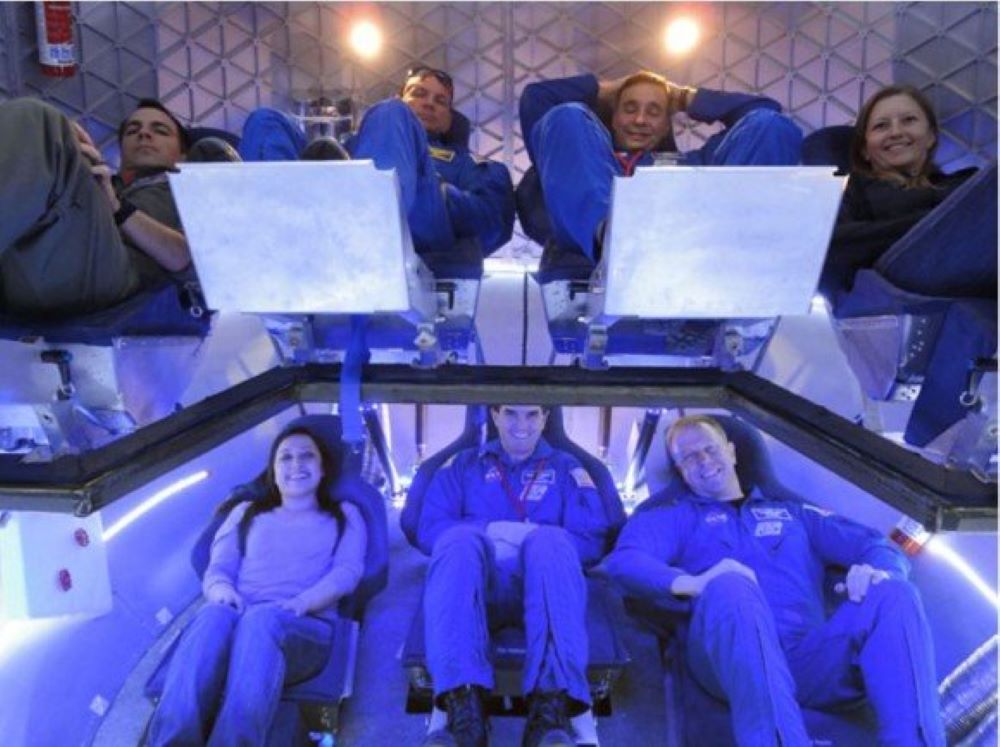
Attention now focussed on the upcoming Crew 9 mission, which was to deliver four astronauts to the station by Crew Dragon in August. That had to be postponed after a previous Falcon 9 failure and subsequent FAA grounding, which was lifted after two weeks. There was already a proposal to bring back Butch Wilmore and Suni Williams on it, though it would mean grounding two of the four Crew 9 astronauts, and it wouldn’t come back until replaced by the Crew 10 capsule in February. That has now been decided upon, but the original NASA contracts for Crew Dragon and Starliner included development of new spacesuits and didn’t specify they had to be interchangeable – so they aren’t, believe it or not. If there were an emergency meantime, such as a serious collision with Starliner or space debris, then Butch and Suni would have to return without suits on the cargo pallet of the Crew 8 dragon – not a comfortable situation and potentially fatal, as happened in 1970 to the crew of Soyuz-11 when returning without suits from Salyut-1, which lost pressure due to a faulty valve. As various commentators have pointed out, Crew Dragon is supposed to be able to carry 7 people with additional seats (Fig. 1), but presumably there isn’t time to modify the Crew 9 capsule which is already a month behind schedule. I haven’t heard whether it will carry suits for Butch and Suni, or they will be taken up on a cargo flight, or Crew 10’s vehicle in February.

No secret is being made of Boeing’s dislike of the situation. They continue to insist that Starliner is safe to come back with crew, and ‘there was tension in the room’ when NASA’s decision was announced. At the moment (Friday 6th) Starliner is scheduled to separate from the station within the hour, and I shall try to comment on that and the landing tomorrow morning, before sending this article.
Meanwhile, the Mercury flyby of ESA’s Bepi-Colombo mission took place on September 4th, the fourth in its series of braking manoeuvres before entering orbit around the planet, was reprogrammed to take account of the diminution of thrust on which I reported previously. The problem has been identified and is due to unintended electrical currents between the solar panels and the rest of the spacecraft. It hasn’t proved possible to remedy the fault, and as a result Bepi-Colombo was reprogrammed to fly 22 miles closer to the planet, gaining a greater gravitational slingshot from the manoeuvre (after whose inventor the spacecraft is named). It returned spectacular images of Mercury, (Fig. 2), even though the main camera will not be uncovered until Bepi-Colombo achieves orbit around the planet. That was to have been in December 2025, but due to the problem Bepi-Colombo will not have enough thrust for that. It won’t do so on its new trajectory until after further flybys in January and December 2025, entering orbit in November 2026, after which it will separate into two for examination of the planet at different orbital inclinations over 1-2 years.

Meanwhile, on September 5th Europe’s Vega small satellite booster made its last flight before retirement, the last flight of 22 since 2012 (Fig. 3). The launch carried a Sentinel 2-C satellite, ‘Copernicus’, replacing Sentinel 2-A in Europe’s Earth observation series. The more advanced Vega-C booster is due to enter service before the end of 2024, with new upper stages, improved propulsion, new payload fairings and new launch facilities at the Kourou spaceport in French Guiana.

In more sad news, just before I wrapped up the September ‘Sky Above You’ (ON, 3rd September 2024 – full story and illustrations), came sad news for Earth-Space science: Salsa, the first of the ESA Cluster satellites to run out of fuel, is to be deorbited on or about September 8th (Fig. 4). Of the remaining three satellites, Rumba will re-enter in November 2025, followed by Tango and Samba in August 2026, all into the ‘Pont Nemo’ disposal area which was used by the Mir space station and others. (David Dickinson, ‘ESA Cluster Satellite to Reenter in Early September’, Universe Today, August 30th 2024.)

Successor missions are in preparation, with SMILE (Solar wind Magnetosphere Ionosphere Link Explorer) launching in late 2025, and Proba-3, continuing another successful series, for launch next month, both going into similar far-ranging orbit around the Earth. Proba-3 will feature a free-flying, solar eclipsing disk, which is a technique which shows promise in the search for earth like exoplanets (Figs. 5 & 6).


With ESA’s Jupiter Icy Moons Explorer (JUICE) successfully past its first Earth flyby (‘The Sky Above You’, ON, 3rd September 2024), attention is now focussed on NASA’s Europa Clipper mission, intended for the same targets. Its Falcon Heavy launch is now scheduled for a window opening on October 10th, with a go or no-go decision to be taken on September 9th, designated ‘Key Decision Pont E’. Europa Clipper is intended to make up to 50 flybys of the ice-covered moon between 2031 and 2034, despite concerns about whether its onboard transistors are sufficiently hardened to withstand that exposure to Jupiter’s radiation belts. Announcing the dates above, NASA released a dramatic artwork showing the spacecraft in front of Europa in front of Jupiter, all in the same three-quarters phase, in the style of 2001, A Space Odyssey (Fig. 7).

The launch of NASA’s Blue and Gold ESCAPADE(Escape and Plasma Acceleration and Dynamics Explorers) spacecraft (Fig. 8), scheduled for October 13th, will be an important test for Blue Origin’s New Glenn booster, on its first flight (Fig. 9).


Blue Origin has announced that it will attempt to recover the first stage with a landing on a seagoing ‘drone ship’, as SpaceX has been doing with its Falcon 9 first stages. ‘Landing Platform Vessel # 1’, named Jacklyn, after the mother of Blue Origin’s Jeff Bezos, was partly built in Romania, completed in Brest, and reached the dock of Port Canaveral, near Kennedy Space Centre, on September 4th (Figs. 10 & 11). That was where I watched the dawn launch of the Space Shuttle Challenger in October 1984 – see ‘Challenger Liftoff, STS-41G, October 1984’, ON, August 7th, 2022.)


Back to Starliner: I joined NASA TV at 22.50 BST. After weather checks for the landing zone, the spacecraft navigation lights were turned on, followed by radar and laser sensors on the spacecraft. With a minute to go, Starliner began powering up the docking latches for separation. Undocking was on schedule at 23.06 BST and was followed by the Breakout Burn, 12 burns of the 27 thrusters working, out of 28, taking Starliner out of the 200-metre Keep-out Sphere, entering the Approach Ellipsoid, from which no collision would occur within 24 hours even if attitude control failed completely, and clearing that 21 minutes after release.
The landing was scheduled for 5.03 BST on Saturday 7th. NASA TV coverage began at 3.15, but I didn’t join until 3.45 because there had to be some concession to sleep. The direct connection to NASA TV failed immediately due to ‘features which are not supported’. On Space.com, I got video but no sound. Checking afterwards, I couldn’t get sound on anything without unplugging the headphones, which wasn’t practical at that time in the morning. So I had to watch in silence as we went through re-entry, drogue parachute deployment, heat shield release, main parachute deployment and descent to an apparently uneventful landing (Fig. 12). (The problem appears to be ‘missing features’ on the computer, which was working fine earlier, but is about to be replaced in any case.) Starliner is the first US capsule to touch down on land rather than at sea, despite the name ‘White Sands Space Harbor’ for the landing site in New Mexico. White Sands is where the earliest postwar rocket launches took place, with V2, WAC Corporal, Viking and Aerobee boosters; it was a backup landing site for the Space Shuttle, used only when both Kennedy Space Centre and Edwards Air Force Base were closed by weather.

The forward docking port on the ISS Harmony module has now been freed for a succession of missions to put operations back on schedule, including a crewed Soyuz launch from Baikonur on Wednesday 11th, a Cargo Dragon delivery, and the launch of Crew 9 on September 24th. With the capsule back on Earth, at least one commentator has suggested it may not fly again. The identical fixed-price contracts issued to SpaceX and Boeing called for seven crewed launches to the ISS; SpaceX has so far performed nine, with the tenth in preparation, but Boeing has yet to achieve any, and as we’ve seen with the recent cancellation of the VIPER moonprobe (ON, August 4th, 2024), once the money is gone, that may well be the end of it. Lack of it could well accelerate the demise of the ISS, cutting back the ambitious programme planned for it in coming years and shifting the emphasis to the Artemis lunar programme, though that too is in difficulties. Artemis II is now at KSC being prepared for the first crewed launch to the Moon since Apollo 17, but there are still unsolved problems with the heat shield which could lead to further delays.
Duncan Lunan’s recent books are available through Amazon; for details see Duncan’s website, http://www.duncanlunan.com.




Leave a Reply